
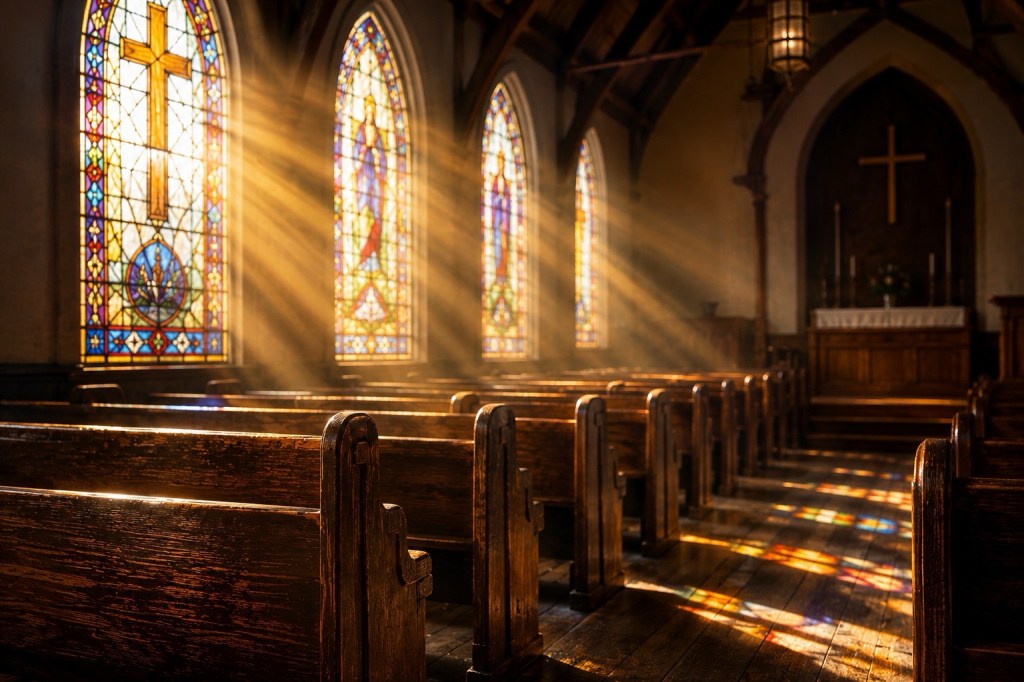
Sunday mornings are special. While the coffee is still brewing and breakfast is waiting to be prepared, the sun breaks through the darkness. The light passes through stained glass to highlight the well worn pews waiting to be filled. There is a majestic glory to that scene. It calls us to leave our screens behind and find forgotten memories of what really matters. Like the light breaking through stained glass windows, Trinitarian theology calls us Heavenward despite our attachment to the latest screen in our hands. We choose distractions, but we know there is something more important.
God calls us through the busy distracting fog of every day life. To “taste and see that the Lord is good,” we have to turn our minds and hearts to Him. Though we are never truly happy, we are all too cheaply satisfied with whatever may distract us. You will never be truly satisfied and truly happy until our hearts and minds are fixed on the Triune God.
The doctrine of the Trinity is often regarded as one of the most difficult teachings of the Christian faith. Many believers affirm it faithfully while struggling to understand its significance for Christian worship and discipleship. Yet Scripture presents the triune identity of God not as a peripheral doctrine but as the very foundation of Christian theology. Every major act of God toward creation and redemption arises from the Father, through the Son, and in the Holy Spirit. The doctrine of the Trinity reveals that God’s blessedness is rooted in His eternal triune life and that believers are redeemed to participate in communion with this living God.
The Unity of God
Christian reflection on the Trinity begins with the unwavering biblical affirmation that there is only one God. The foundational confession of Israel declares: “Hear, O Israel: The LORD our God, the LORD is one” (Deut 6:4). This conviction governs the entire biblical narrative. The Lord repeatedly distinguishes Himself from every false deity: “I am the LORD, and there is no other, besides me there is no God” (Isa 45:5).
The New Testament continues this confession without modification. Paul writes: “There is one God” (1 Tim 2:5). Likewise: “There is no God but one” (1 Cor 8:4).
The doctrine of the Trinity does not compromise biblical monotheism. Rather, it seeks to explain all the biblical data while preserving the absolute unity of God. The church sought to understand how the one God revealed Himself through the Father, Son, and Holy Spirit.
The Deity of the Son
The New Testament consistently attributes full deity to Jesus Christ. John opens his Gospel with words that deliberately echo Genesis: “In the beginning was the Word, and the Word was with God, and the Word was God” (John 1:1). Several truths appear simultaneously. The Word exists eternally. The Word is personally distinct from God the Father. The Word Himself is fully divine.
Later John declares: “And the Word became flesh and dwelt among us” (John 1:14). The eternal Word who is God becomes incarnate without ceasing to be who He eternally is. The testimony of Thomas provides one of the clearest christological confessions in Scripture: “My Lord and my God!” (John 20:28). Importantly, Jesus receives this confession rather than correcting it.
Paul likewise describes Christ as:“our great God and Savior Jesus Christ” (Titus 2:13). The author of Hebrews applies Psalm 45 directly to the Son: “Your throne, O God, is forever and ever” (Heb 1:8). These texts demonstrate why the church confessed the Son as fully divine while remaining personally distinct from the Father.
The Deity of the Holy Spirit
The Holy Spirit is not merely an impersonal force or divine influence. Scripture presents Him as a divine person who acts, speaks, teaches, guides, and wills. When Ananias deceives the church, Peter asks: “Why has Satan filled your heart to lie to the Holy Spirit?” (Acts 5:3). Peter then concludes: “You have not lied to man but to God” (Acts 5:4). The Spirit possesses divine knowledge: “The Spirit searches everything, even the depths of God” (1 Cor 2:10). He possesses divine sovereignty: “All these are empowered by one and the same Spirit, who apportions to each one individually as he wills” (1 Cor 12:11). He is omnipresent: “Where shall I go from your Spirit? Or where shall I flee from your presence?” (Ps 139:7).
The biblical evidence compelled the church to confess that the Holy Spirit is fully God.
The Triune Revelation of God
Many biblical passages reveal the Father, Son, and Spirit acting together as the 3 “persons” who are the 1 God (remember when we call each Person a “person,” we do so only because we do not have a better word. Perhaps subsistence would be more accurate, but we use “person” knowing it is not entirely accurate. God is far more than we can comprehend).
At Jesus’ baptism: “When Jesus was baptized, immediately he went up from the water, and behold, the heavens were opened to him, and he saw the Spirit of God descending like a dove and coming to rest on him; and behold, a voice from heaven said, ‘This is my beloved Son, with whom I am well pleased’” (Matt 3:16-17). The Father speaks. The Son is baptized. The Spirit descends. The three persons are simultaneously present while remaining distinct.
The same pattern appears in the Great Commission: “Go therefore and make disciples of all nations, baptizing them in the name of the Father and of the Son and of the Holy Spirit” (Matt 28:19). The singular term “name” is particularly significant. Jesus does not speak of three names but one divine name shared by the Father, Son, and Spirit. Paul’s benediction reflects the same trinitarian structure: “The grace of the Lord Jesus Christ and the love of God and the fellowship of the Holy Spirit be with you all” (2 Cor 13:14). These passages formed the biblical foundation for the church’s trinitarian doctrine.
The Eternal Love of God
The doctrine of the Trinity answers a profound theological question: How can Scripture say that “God is love” (1 John 4:8)? Love requires relationship. If God were eternally solitary, love would only become actualized after creation. Divine love would then depend upon creatures.
In His high priestly prayer, Jesus addresses the Father: “You loved me before the foundation of the world” (John 17:24). Before creation existed, the Father loved the Son. Jesus repeatedly speaks of this eternal fellowship: “The Father loves the Son and has given all things into his hand” (John 3:35). Again: “For the Father loves the Son and shows him all that he himself is doing” (John 5:20).
The eternal life of God is therefore not characterized by isolation but by perfect communion. The Father eternally delights in the Son, and the Son eternally delights in the Father in the fellowship of the Holy Spirit. As we recognize the significance of these biblical texts, we can better understand why the Spirit is described as the bond of love between Father and Son. While Scripture does not reduce the Spirit to this role alone, this insight captures an important truth concerning the interpersonal life of God.
The Blessedness of God
The triune life of God reveals why God is infinitely blessed. Scripture repeatedly presents God as the “blessed God” (1 Tim 1:11; 6:15). Divine blessedness refers to God’s perfect fullness, satisfaction, and joy in Himself. God does not require creation to complete Him. He does not need worshippers to enrich Him. He does not depend upon the world to experience happiness.
Paul proclaims to the Athenians: “Nor is he served by human hands, as though he needed anything” (Acts 17:25). God possesses the fullness of life in Himself. The Father’s delight in the Son and the Son’s delight in the Father reveal an eternal communion of perfect love and joy. Divine blessedness is not merely an attribute added to God. It is the lived reality of God’s triune life.
Because God is eternally blessed in Himself, creation is not the result of deficiency. God creates from abundance rather than need. Redemption likewise proceeds from the overflow of divine goodness rather than from any lack within God.
Participation in the Life of God
The gospel does more than secure forgiveness. Through Christ believers are brought into fellowship with the triune God. Peter speaks of believers becoming: “partakers of the divine nature” (2 Pet 1:4). This does not mean believers become divine in essence. Rather, they participate in the life and fellowship that God graciously shares with His people.
Jesus prays: “That they may all be one, just as you, Father, are in me, and I in you” (John 17:21). Believers are drawn into communion with the Father through the Son in the Holy Spirit. Paul explains: “For through him we both have access in one Spirit to the Father” (Eph 2:18).
Every aspect of salvation possesses a trinitarian structure. The Father elects, the Son redeems, and the Spirit applies redemption. The believer’s life unfolds within the gracious communion of the triune God.
Conclusion
The doctrine of the Trinity is not an abstract appendix to Christian theology. It is the church’s confession of who God eternally is. Scripture reveals one God who exists as Father, Son, and Holy Spirit. The Father loves the Son. The Son loves the Father. The Holy Spirit eternally proceeds from and glorifies the Father and the Son.
This triune life explains why God is eternally blessed, why creation flows from abundance rather than necessity, and why redemption culminates in communion with God Himself.
Focus your attention beyond yourself. Do what is necessary to welcome the light of God into your heart and mind. Trinitarian theology calls believers to contemplate the living God whose fullness, joy, and glory existed before the foundation of the world and whose blessed life has now been opened to sinners through Jesus Christ. The final goal of salvation is not merely rescue from judgment. It is fellowship with the Father through the Son in the Holy Spirit, forever.

Leave a Reply