
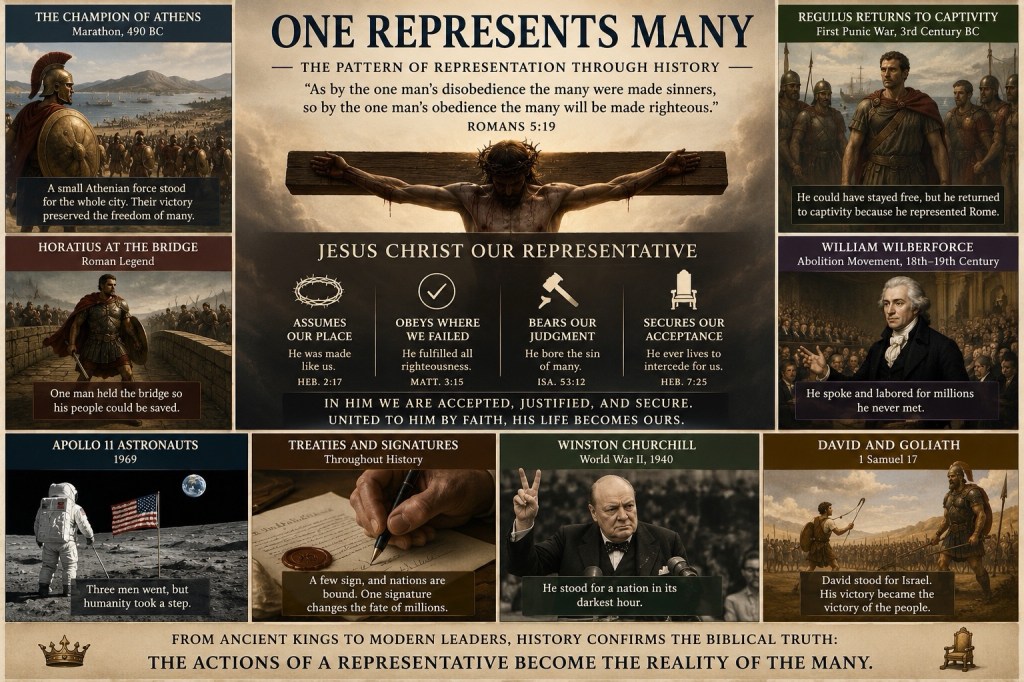
When Apollo 11 Moon Landing occurred, only three men traveled to the moon. Yet the event was experienced as a human achievement. When Neil Armstrong stepped onto the lunar surface, newspapers around the world described it as humanity taking a step onto another world. Of course, humanity did not literally walk there. One man did. Yet he acted representatively for an entire people. The achievement of one became the achievement of many.
From the opening pages of Scripture to its final vision of redemption, God relates to his people through a representative. This theme reaches its climax in Jesus Christ, the mediator who stands before the Father on behalf of sinners. The gospel is not fundamentally the story of human beings climbing their way to God through moral effort or religious devotion. It is the announcement that God has provided a perfect representative who accomplishes for his people what they could never accomplish for themselves. In Christ, believers find one who obeys where they failed, suffers what they deserved, and secures the acceptance they could never earn. Understanding his representative work is therefore essential to understanding the heart of the Christian faith.
Jesus stands before the Father as our representative. He assumes our place, fulfills our obligations, bears our judgment, and secures our acceptance. The whole Christian life rests upon this reality. We are saved not because we finally become adequate before God, but because another has stood in our place and acted on our behalf.
Adam and Christ: The Two Covenant Heads
Scripture unfolds this truth through the pattern of covenant representation. Humanity’s story begins with Adam, whom God appointed as the head and representative of the human race. Adam did not act merely as a private individual. He stood in a public capacity. His obedience would have secured blessing for those united to him; his disobedience brought condemnation upon all whom he represented. The covenantal dimensions of Adam’s role are already suggested in Genesis 2–3, where the destiny of the entire human family hangs upon the obedience of one man. Paul writes, “sin came into the world through one man, and death through sin” (Rom 5:12). Adam’s transgression became the transgression of humanity because Adam functioned as humanity’s covenant head. He summarizes this saying: “For as in Adam all die” (1 Cor 15:22). The text Adam locates humanity within Adam as its representative source and covenantal head. Likewise, Romans 5:18 states that “one trespass led to condemnation for all men,” emphasizing the judicial consequences of Adam’s representative act.
Yet the story of redemption turns upon God’s appointment of a second and greater representative. Paul deliberately constructs a parallel between Adam and Christ: “For as by the one man’s disobedience the many were made sinners, so by the one man’s obedience the many will be made righteous” (Rom 5:19). The repeated phrase, “the one,” is not incidental. Paul wants readers to see two covenant heads standing over two humanities. Adam’s act brought condemnation; Christ’s act brings justification. Adam plunged his people into death; Christ raises his people into life. The decisive question is therefore not merely what we have done, but to whom we belong. Paul reinforces this contrast in 1 Corinthians 15:45–49, where Christ is called “the last Adam.” The expression last Adam identifies Christ not merely as another representative but as the final and definitive covenant head whose obedience inaugurates a new humanity. Jesus was not the last man except that he is the last representative for mankind. Where the first man was “from the earth, a man of dust,” the second man is “from heaven,” possessing the power to impart resurrection life to all who are united to him.
Old Testament Types of Representation
The representative principle appears throughout the Old Testament. Noah preserves humanity through God’s covenant mercy (Gen 6–9). Abraham receives promises that extend to his offspring and ultimately to the nations (Gen 12:1–3; Gal 3:16). The kings of Israel stand as covenant representatives whose faithfulness or rebellion affects the people under their rule. David’s victory over Goliath functions representatively, as the triumph of the anointed king becomes the triumph of the nation he represents. Likewise, the high priest enters the Holy of Holies bearing the names of the tribes of Israel upon his breastpiece (Exod 28:29), symbolizing his representative role before God.
The Suffering Servant as Representative Substitute
This representative structure reaches its fullest expression in the suffering Servant of Isaiah 53. The prophet repeatedly describes a figure who bears the guilt of others. “He bore the sin of many” (Isa 53:12). The Hebrew verb nāśāʾ carries the sense of carrying away, lifting up, and bearing a burden that belongs to another. The Servant does not merely sympathize with sinners. He carries their guilt before divine judgment. The language throughout the chapter is substitutionary. “He was pierced for our transgressions” and “crushed for our iniquities” (Isa 53:5). The repeated prepositions underscore a profound exchange. The judgment belonging to others falls upon him. Isaiah further declares that “the LORD has laid on him the iniquity of us all” (Isa 53:6). The Hebrew verb hipgîaʿ, translated “laid on,” conveys the idea of causing something to strike or fall upon another. The covenantal guilt of God’s people converges upon the Servant, who stands in their place under divine judgment. This imagery echoes the Day of Atonement ritual in Leviticus 16, where the sins of Israel are symbolically transferred to the scapegoat and carried away into the wilderness.
Christ the Fulfillment of the Representative Pattern
The New Testament identifies Jesus as the fulfillment of this prophetic vision. John the Baptist introduces him as “the Lamb of God, who takes away the sin of the world” (John 1:29), language that evokes both Passover imagery and sacrificial substitution. Paul declares that God “made him to be sin who knew no sin, so that in him we might become the righteousness of God” (2 Cor 5:21). The passive verb epoiēsen points to the Father’s sovereign action in appointing the Son to this mediatorial role. The cross is not an isolated act of self-sacrifice detached from the Father’s will. It is the execution of the eternal purpose of the triune God.
The Father sends, the Son obeys, and the Spirit applies the accomplished redemption. Christ represents a definite people whom the Father has given him from eternity (John 17:2, 6, 9, 24). The phrase “in him” (en autō) in 2 Corinthians 5:21 is crucial, for it locates the believer’s righteousness not in personal achievement but in union with Christ. Similarly, Galatians 3:13 declares that “Christ redeemed us from the curse of the law by becoming a curse for us.” The Greek preposition hyper (“for us”) frequently carries representative and substitutionary force throughout Paul’s writings.
The Priestly Work of Christ
The Epistle to the Hebrews develops this representative ministry through the imagery of priesthood. To represent sinners before God, the Son had to become truly human. “He had to be made like his brothers in every respect” (Heb 2:17). The verb homoiōthēnai emphasizes genuine solidarity. The eternal Son assumed our nature without ceasing to be what he eternally is. He entered our condition, experienced our weakness, endured temptation, and suffered death. Yet unlike every Levitical priest, he remained without sin. Consequently, he did not offer sacrifices for himself before interceding for others. Instead, “he offered up himself” (Heb 7:27). The sacrifice and the priest converge in a single person. The one who stands for sinners is himself the offering through which sinners are reconciled. Hebrews 2:17 further describes him as a “merciful and faithful high priest” who makes “propitiation” for the sins of the people. The Greek term hilaskesthai refers to the turning away of divine wrath through an atoning sacrifice. Christ’s priestly ministry therefore addresses not only human guilt but also God’s righteous judgment against sin.
Christ’s Heavenly Intercession
The priestly work of Christ did not cease at Calvary. Hebrews repeatedly directs our attention to the ascended Christ who has entered the heavenly sanctuary. “We have a great high priest who has passed through the heavens” (Heb 4:14). The earthly tabernacle was only a shadow. Christ enters the true holy place, appearing in the presence of God on behalf of his people (Heb 9:24). His intercession rests not upon repeated sacrifice but upon a finished work. The wounds of the crucified and risen Lord remain the everlasting testimony that atonement has been accomplished. Hebrews 7:25 therefore declares that “he always lives to make intercession for them.” The Greek verb entynchanein denotes active advocacy and petition. Christ’s heavenly ministry is not a continuation of his sacrifice but the perpetual presentation of its completed efficacy before the Father. As our representative, he appears coram Deo—before the face of God—for us.
Christ the Mediator of the Covenant
The representative role of Christ is also illuminated through the biblical concept of mediation. First Timothy 2:5 states, “There is one God, and there is one mediator between God and men, the man Christ Jesus.” The Greek term mesitēs refers to one who stands between two parties to establish peace and covenant fellowship. Moses functioned as a mediator under the old covenant, but Christ is the mediator of a better covenant established on better promises (Heb 8:6). His mediation succeeds because he uniquely possesses both full deity and full humanity. As God, he can reveal the Father perfectly; as man, he can represent humanity perfectly.
Historical Reflection on Christ’s Representative Work
The church’s greatest theologians recognized the centrality of this representative work. Irenaeus described Christ’s mission through the doctrine of recapitulation. The Son retraces humanity’s path and succeeds where Adam failed. “He therefore completely renewed all things” (Against Heresies 3.18.1). Athanasius captured the logic of redemptive exchange when he wrote, “He became what we are that He might make us what He is” (On the Incarnation 54). Thomas Aquinas later argued that Christ, as the head of the church, merited grace for all his members through his obedience (Summa Theologiae III, q. 48, a. 1-2). Calvin sharpened the forensic dimension of this truth, insisting that Christ became our surety and substitute before divine judgment (Institutes 2.16.5).
Active and Passive Obedience
This representative work includes both what theologians have traditionally called Christ’s active and passive obedience. Through his active obedience, Christ fulfills every demand of God’s law. He loves the Father with perfect devotion and loves his neighbor with perfect righteousness. Every command that Adam violated and every duty that Israel neglected finds its fulfillment in Jesus Christ. His declaration at the Jordan River, where the Father announces, “This is my beloved Son, with whom I am well pleased” (Matt 3:17), reflects a life of perfect covenant fidelity. Through his passive obedience, Christ willingly bears the curse and penalty that sin deserves. Philippians 2:8 summarizes this descent: “He humbled himself by becoming obedient to the point of death, even death on a cross.” Christ’s suffering was an act of covenant obedience. These two dimensions belong together. The Savior not only removes guilt; he provides righteousness. He not only pays a debt; he secures an inheritance.
Resurrection and Vindication
The resurrection publicly vindicates this representative achievement. Paul writes that Christ “was delivered up for our trespasses and raised for our justification” (Rom 4:25). The resurrection is God’s declaration that the work of the mediator has been accepted. Death has exhausted its claim. Judgment has been satisfied. The representative emerges victorious from the grave because the sins he carried have been fully atoned for. His vindication becomes the vindication of all who are united to him. Romans 1:4 states that he was “declared to be the Son of God in power” through the resurrection. The resurrection does not make him the Son; rather, it publicly manifests and vindicates his identity and mission. As the risen covenant head, he becomes “the firstfruits of those who have fallen asleep” (1 Cor 15:20), guaranteeing the future resurrection of his people.
Union with Christ
Union with Christ therefore stands at the center of salvation. By faith and through the regenerating work of the Holy Spirit, believers are joined to the risen Lord. What belongs to Christ becomes theirs. His righteousness is counted as theirs. His sonship becomes theirs by adoption. His access to the Father becomes theirs through grace. Believers stand before God clothed not in the tattered garments of their own obedience but in the perfect righteousness of the incarnate Son. Paul’s repeated use of the phrase en Christō (“in Christ”) throughout his letters underscores this reality. Ephesians 1 alone repeatedly speaks of believers being chosen, redeemed, forgiven, and sealed “in Christ.” Union with Christ is the fountain from which every saving blessing flows.
Justification by Christ’s Representation
This doctrine strikes at every form of self-justification. Fallen humanity instinctively seeks acceptance through performance, achievement, morality, or religious devotion. The gospel announces something altogether different. Acceptance before God rests entirely upon the obedience and satisfaction of another. Boasting is excluded because salvation is received rather than achieved. Faith does not contribute righteousness; it receives the righteousness of Christ. Romans 3:28 therefore concludes that “one is justified by faith apart from works of the law.” The verb dikaioō is forensic in nature, referring to a judicial declaration of righteousness rather than a process of moral transformation. God declares believers righteous because they are represented by the righteous One.
Sanctification and Conformity to Christ
Yet this gracious reality never produces spiritual passivity. Union with the representative necessarily produces conformity to the representative. The Christ who stood for us now lives in us through his Spirit. Justification gives rise to sanctification. Those declared righteous are progressively transformed into the image of the righteous One. The same Savior who secured our acceptance now renews our hearts and directs our lives. Romans 8:29 teaches that believers are predestined “to be conformed to the image of his Son.” Because Christ is both representative and head, those united to him inevitably share in his life and likeness through the sanctifying work of the Spirit.
Comfort and Assurance in Our Representative
Here the believer finds profound comfort. The One who calmed the sea now stands in the presence of the Father on behalf of his people. The One who bore the storm of divine judgment now intercedes for those united to him. No accusation can ultimately prevail against those represented by Christ, for the verdict has already been rendered in their favor. Romans 8:33–34 asks, “Who shall bring any charge against God’s elect?” and immediately points to the risen and interceding Christ as the answer. Their standing before God rests not upon the instability of their performance but upon the unchanging obedience of the Son. In him they are accepted, justified, reconciled, and secure. Their lives are hidden with Christ in God (Col 3:3), and their future is bound forever to the One who represents them before the throne. The final vision of Scripture confirms this hope, for the redeemed stand before God not in their own merit but in the Lamb’s righteousness, singing, “Worthy is the Lamb who was slain” (Rev 5:12). From Genesis to Revelation, the message remains the same: sinners are saved because God has provided a perfect representative, Jesus Christ our Lord.

Leave a Reply