
The Scriptures teach us that Jesus Christ possesses the fullness of the divine nature (John 1:1; Col. 1:19; 2:9; Heb. 1:3) and that he assumed the fullness of our human nature (John 1:14; Rom. 8:3; Gal. 4:4; Heb. 2:14–17). What are we affirming when we confess that Jesus is truly God and truly man? Surely we mean that he possesses everything essential to both natures.
We should distinguish between the person who wills, the faculty by which he wills, and the thing he wills. There is one person of the Son who eternally possesses the divine will and who assumed a human will when he became man. We can affirm the perfect agreement of Christ’s divine and human willing without denying either faculty. Since the faculty of willing is essential to both divine and rational human nature, we should consider the consequences of denying either will.
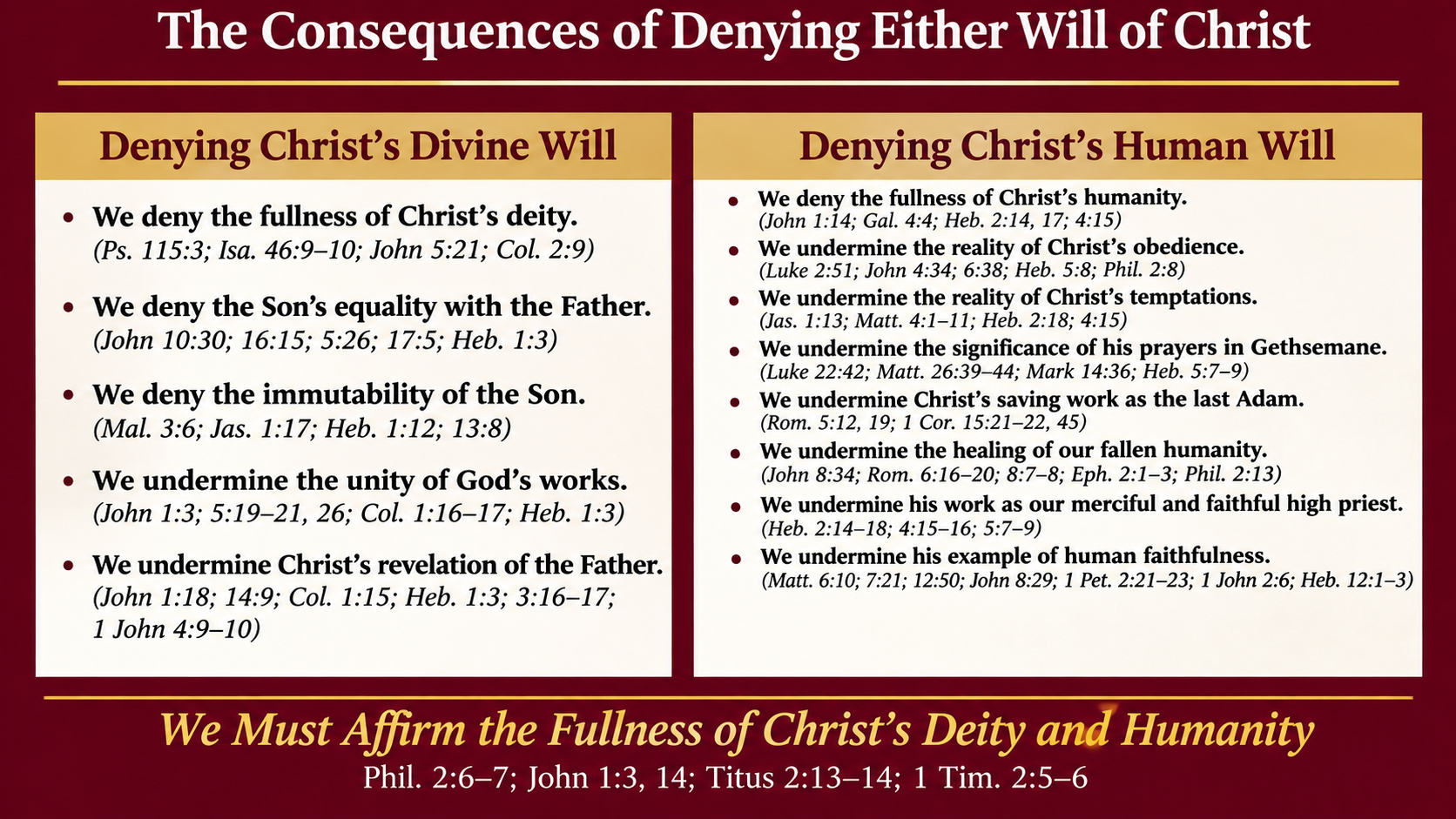
The Consequences of Denying Christ’s Divine Will
- We deny the fullness of Christ’s deity. God accomplishes all that he wills (Ps. 115:3; 135:6; Isa. 46:9–10; Eph. 1:11). Notice what Jesus taught concerning his relationship with the Father. Just as the Father raises the dead and gives them life, “so also the Son gives life to whom he will” (John 5:21). Jesus grounds these works in the divine life he possesses from the Father (John 5:26). Since the whole fullness of deity dwells bodily in Christ (Col. 2:9), we must affirm that the Son possesses the divine will.
- We deny the Son’s equality with the Father. Jesus said, “I and the Father are one” (John 10:30), and “All that the Father has is mine” (John 16:15). The Son possesses the same divine life as the Father (John 5:26), shares in his divine glory (John 17:5), and is the exact imprint of his nature (Heb. 1:3). How then could the Son lack the divine will?
- We deny the immutability of the Son. Scripture teaches us that God does not change (Mal. 3:6; Jas. 1:17). The author of Hebrews applies the words of Psalm 102:25–27 to the Son: “You are the same, and your years will have no end” (Heb. 1:12). If the Son relinquished his divine will when he became man, he would have ceased to possess a perfection of his divine nature. We must distinguish between the Son’s willingness to humble himself for our salvation (Phil. 2:6–8) and the loss of something essential to his deity.
- We undermine the unity of God’s works. All things were created through the Son (John 1:3; Col. 1:16; Heb. 1:2). All things continue to exist through him (Col. 1:17; Heb. 1:3). Jesus taught that whatever the Father does, the Son does likewise (John 5:19). The Father raises the dead, and the Son gives life to whom he wills (John 5:21). Did the Son cease to will the existence of the world when he became man? The Father, Son, and Holy Spirit possess one divine will because they possess one divine nature.
- We undermine Christ’s revelation of the Father. The Son has made the Father known (John 1:18). To see Jesus is to see the Father (John 14:9). The Son is the image of the invisible God (Col. 1:15), the radiance of his glory, and the exact imprint of his nature (Heb. 1:3). The Father sent the Son for our salvation (John 3:16–17; 1 John 4:9–10), and the Son willingly gave himself for us (Gal. 2:20; Eph. 5:2). We see the goodness of the one divine will in the saving work of Jesus.
The Consequences of Denying Christ’s Human Will
- We deny the fullness of Christ’s humanity. The Word became flesh (John 1:14). The Son was born of a woman (Gal. 4:4), descended from David according to the flesh (Rom. 1:3), and shared in our flesh and blood (Heb. 2:14). He was made like his brothers in every respect (Heb. 2:17), yet without sin (Heb. 4:15). The capacity to will belongs to our rational human nature (Rom. 7:18–21; 1 Cor. 7:37). God created us with this capacity, and there was nothing sinful about it (Gen. 1:26–31). What biblical reason do we have for denying that the Son assumed it?
- We undermine the reality of Christ’s human obedience. Jesus was obedient to his earthly parents (Luke 2:51). He came to do the will of the Father (John 4:34; 6:38; Heb. 10:7). He learned obedience through what he suffered (Heb. 5:8) and became obedient to the point of death (Phil. 2:8). According to which nature did Jesus learn obedience? Surely we would agree that the divine nature has no need to learn. The Son rendered this obedience according to the human nature he assumed.
- We undermine the reality of Christ’s temptations. God cannot be tempted with evil (Jas. 1:13). However, Jesus was tempted in the wilderness (Matt. 4:1–11), suffered when tempted (Heb. 2:18), and was tempted in every respect as we are, yet without sin (Heb. 4:15). The Son experienced these temptations according to his human nature. He willingly remained faithful to God even when he was hungry and suffering.
- We undermine the significance of Christ’s prayer in Gethsemane. Jesus prayed, “Nevertheless, not my will, but yours, be done” (Luke 22:42; cf. Matt. 26:39–44; Mark 14:36). There was nothing sinful about Jesus’ desire to be spared suffering and death. Death is our enemy (1 Cor. 15:26). Since the Father and Son share one divine nature and will (John 5:19–21; 10:30; 16:15), we see in Gethsemane the submission of Christ’s human will to the divine will. Jesus willingly endured the suffering he had prayed might pass from him (Heb. 5:7–9).
- We undermine Christ’s saving work as the last Adam. Through one man sin and death entered the world (Rom. 5:12). Through the disobedience of one man many were made sinners, and through the obedience of one man many will be made righteous (Rom. 5:19). As death came through a man, the resurrection of the dead also comes through a man (1 Cor. 15:21–22). The last Adam (1 Cor. 15:45) assumed our humanity and rendered to God the obedience Adam failed to render. How could Jesus render perfect human obedience if he lacked the human faculty of willing?
- We undermine the healing of our fallen humanity. Our wills have been corrupted by sin (John 8:34; Rom. 6:16–20; 8:7–8; Eph. 2:1–3). We stand in need of renewal so that we might desire and do what pleases God (Rom. 12:2; Phil. 2:13; Heb. 13:20–21). In his argument against Apollinarianism, Gregory of Nazianzus insisted that what Christ did not assume he did not heal (Epistle 101). Surely we would agree that our wills stand in need of healing. Gregory’s argument concerning the completeness of Christ’s humanity helps us see the importance of the human will of Jesus for our salvation.
- We undermine Christ’s work as our merciful and faithful high priest. Jesus shared in our humanity so that he might make propitiation for our sins (Heb. 2:14–17). Because he suffered when tempted, he is able to help those who are being tempted (Heb. 2:18). We have a high priest who sympathizes with our weaknesses (Heb. 4:15–16), who learned obedience through suffering, and who became the source of eternal salvation to all who obey him (Heb. 5:7–9).
- We undermine Christ’s example of human faithfulness. Jesus taught his disciples to do the will of the Father (Matt. 6:10; 7:21; 12:50). Jesus himself always did what pleased the Father (John 8:29). We are called to follow in his steps (1 Pet. 2:21–23), walk as he walked (1 John 2:6), and endure suffering as he endured suffering (Heb. 12:1–3). The Son loved God with all his heart, soul, mind, and strength (cf. Mark 12:30). In Jesus we see what human life ought to be.
We Must Affirm the Fullness of Christ’s Deity and Humanity
We should be charitable toward those who disagree with us concerning the two wills of Christ. Many sincerely affirm the fullness of Christ’s deity and humanity. The consequences we have considered concern the consistency of denying either natural faculty with those affirmations. We must also remember that two natural wills do not require two persons. The same Jesus who knows all things (John 21:17) grew in wisdom (Luke 2:52). The one Son knows and wills according to both natures.
The Son who was in the form of God took the form of a servant (Phil. 2:6–7). He who made all things became flesh (John 1:3, 14). He who eternally possesses life in himself willingly laid down his life for us (John 5:26; 10:17–18). What perfection of the divine nature did the Son cease to possess when he became man? What essential faculty of our human nature did he fail to assume?
We have good reason to rejoice in the fullness of Christ’s deity and humanity. The Son who eternally willed our salvation as God became man and willingly gave himself for us. He is our great God and Savior (Titus 2:13–14) and the one mediator between God and humanity (1 Tim. 2:5–6). We dare not deny anything essential to the deity or humanity of our Lord.

Leave a Reply