How can the one who is “in the form of God” become obedient unto death without ceasing to be what he eternally is (Phil 2:6–8)? The question is not peripheral to Christology. It presses directly upon the confession that the one Lord Jesus Christ is both truly God and truly man. Scripture attributes to the same Christ divine glory and human weakness, omnipotent authority and creaturely dependence, eternal preexistence and temporal growth. The task of Christology is not to dissolve these tensions, but to confess them without confusing the natures or dividing the person.
William Lane Craig and J. P. Moreland have proposed a modern rehabilitation of Apollinarian Christology intended to meet precisely this difficulty. Their model, usually called Neo-Apollinarianism, maintains that the eternal Logos himself functions as the rational soul of Jesus. Christ therefore possesses a human body, while the Logos supplies the rational, volitional, and personal capacities normally associated with a human soul. Craig explains that the divine dimensions of the Logos remain largely beneath the level of Christ’s ordinary waking consciousness so that Jesus can live a recognizably human cognitive life while retaining the fullness of deity.
The attractiveness of the model is clear as it seeks to secure the unity of Christ’s person without producing a second human personal subject. Yet its solution creates a more serious difficulty than the one it intends to solve. If the Logos substitutes for the created rational soul proper to humanity, then Christ lacks precisely that constituent of humanity through which human beings know, deliberate, will, obey, suffer, and mature. Craig has also acknowledged the logical consequence of the model: Neo-Apollinarianism entails monothelitism, since the Logos himself is the soul of Jesus and therefore Christ has one will.
The question, then, is not whether Neo-Apollinarianism is an ingenious model. It is whether its account of Christ can sustain the biblical confession that the eternal Son assumed our humanity in its fullness while remaining without alteration in his deity. My argument is that it cannot. Neo-Apollinarianism fails because it cannot preserve the integrity of Christ’s humanity without making the divine Logos perform the constitutive work of a human rational soul. Once the model embraces monothelitism, it also comes into conflict not only with later conciliar Christology but with the biblical depiction of Christ’s genuinely human obedience. At the same time, its strategy for preserving full deity raises serious problems for divine simplicity, immutability, and the distinction between divine and human operations.
1. The Problem Neo-Apollinarianism Is Trying to Solve
Craig and Moreland are responding to a genuine Christological pressure. Classical Christology affirms that Christ is one person subsisting in two complete natures. Yet this immediately generates difficult questions.
- How can the same person be omniscient and yet “increase in wisdom” (Luke 2:52)?
- How can he be impassible according to deity and yet suffer and die?
- How can he possess the divine will and yet pray, “not my will, but yours, be done” (Luke 22:42)?
The Christian tradition eventually learned from the Scriptural data to answer these questions not by reducing either nature but by distinguishing the level at which predicates are true. Christ grows according to his humanity. Christ is eternal according to his deity. The person is one; the natures are distinct.
Neo-Apollinarianism takes a different route. Craig wishes to avoid what he regards as the danger of two personal centers in Christ. He therefore follows Apollinarius at the crucial point: the Logos is Christ’s rational soul. The difference from ancient Apollinarianism is that Craig insists that the Logos possesses all the capacities required for genuine humanity. Rationality, self-consciousness, freedom, and other mental properties already belong to the Logos. When united to a human body, those capacities are said to complete a genuine human nature.This is an important improvement over crude Apollinarianism, but it does not solve the underlying problem. It relocates it. The central question is: Can an uncreated divine intellect be the created human intellect proper to Christ’s humanity? If the answer is no, the model has not provided a complete human nature.
2. Scripture Requires More Than a Human Body
The biblical case for Christ’s full humanity is much stronger than the bare affirmation that he possessed flesh. Hebrews 2:17 says that “he had to be made like his brothers in every respect”: ὅθεν ὤφειλεν κατὰ πάντα τοῖς ἀδελφοῖς ὁμοιωθῆναι. The force of κατὰ πάντα is difficult to reconcile with a Christ whose rational soul is not a created human soul but the eternal divine Logos. The writer of Hebrews grounds Christ’s priestly work precisely in the completeness of his assumed humanity. He shares “flesh and blood” (Heb 2:14), suffers temptation (2:18), learns obedience through suffering (5:8), and offers prayers “with loud cries and tears” (5:7). These are not merely bodily experiences. They implicate cognition, desire, deliberation, affect, and will. Christ does not merely possess a human organism. He lives a human life from within.
Luke makes the same point from another angle saying, “Jesus increased in wisdom and in stature and in favor with God and man” (Luke 2:52). Growth in stature can be bodily. Growth in wisdom cannot be reduced to the body. A truly human cognitive life is being described. Likewise, in Gethsemane Christ says, “Not my will, but yours, be done” (Luke 22:42). This verse does not by itself settle every metaphysical question concerning wills and natures. Yet it certainly depicts a genuinely human willing in the incarnate Son, one that recoils from death while freely submitting to the Father. That distinction becomes increasingly important when placed beside John 6:38: “I have come down from heaven, not to do my own will but the will of him who sent me.” The incarnate mission involves obedience. And obedience is not an abstraction. It belongs to the human enactment of the Son’s mission.
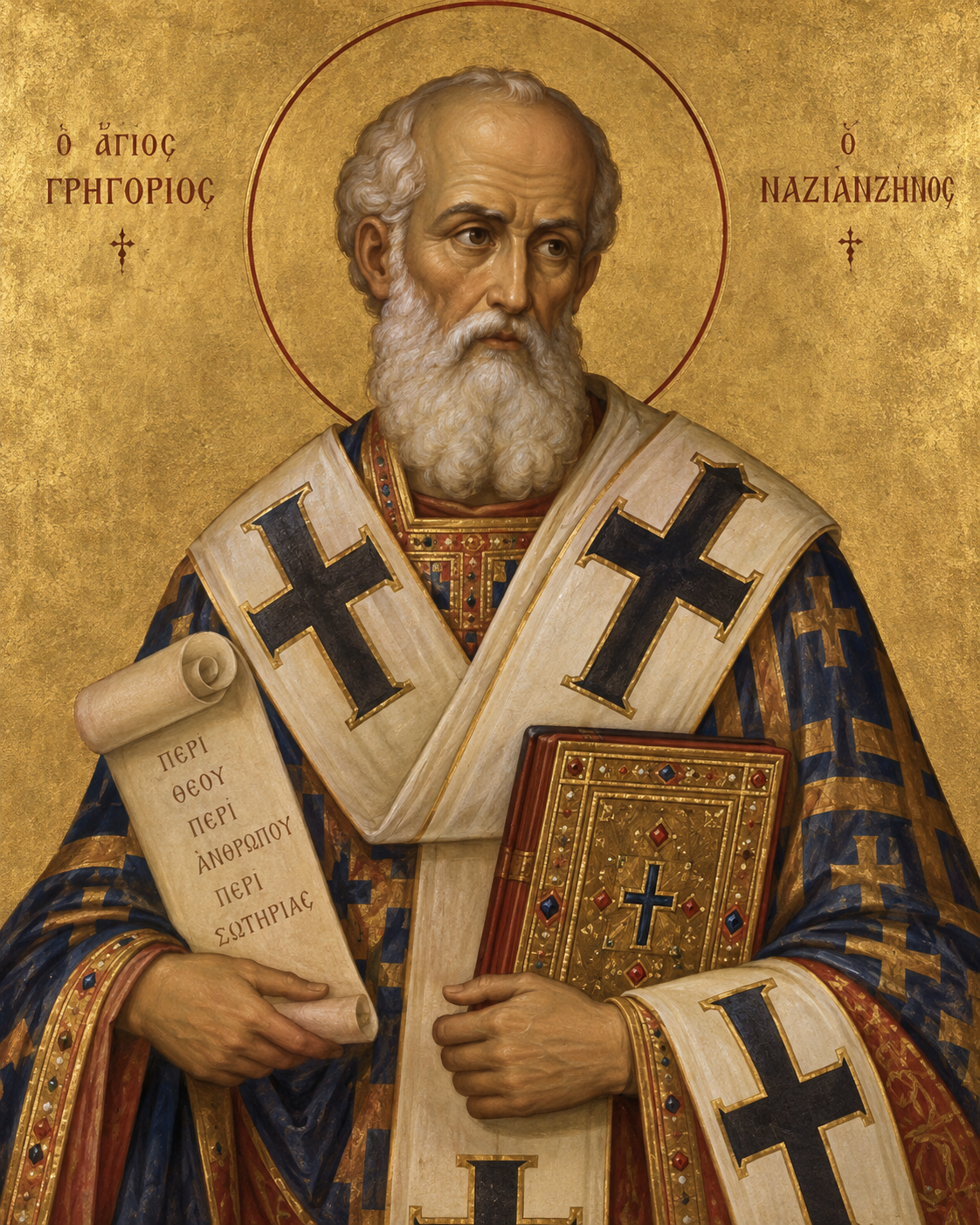
3. Gregory of Nazianzus and Apollinarian Christology
The ancient critique of Apollinarianism remains devastating because it exposes the soteriological stakes of Christology. Gregory of Nazianzus famously argued, “What has not been assumed has not been healed” (Gregory of Nazianzus, Ep. 101.32). This principle is a compressed inference from the biblical logic of redemption. Sin corrupts the whole human person, including the mind, will, desires, and obedience (Rom 1:21–28; 8:7; Eph 4:17–19). Consequently, the redemption of humanity requires the assumption of complete human nature. If the rational soul is excluded from the incarnation, a constituent of the very humanity requiring salvation remains unassumed.
Hebrews establishes the connection between Christ’s assumption of humanity and the salvation of humanity. Because those whom the Son came to redeem share in flesh and blood, he himself partook of the same nature (Heb 2:14). He therefore had to become like his brothers in every respect to serve as their merciful and faithful high priest and make propitiation for their sins (Heb 2:17). His likeness to us cannot be reduced to the possession of human flesh. The Son assumes complete human nature to redeem those who possess it. A Christ whose rational soul is replaced by the divine Logos would lack a constituent of the humanity he came to save.
The Gospel narratives likewise present Christ as possessing a genuinely human intellect and will. Luke declares that Jesus grew in wisdom (Luke 2:52), indicating the real development of human understanding rather than an increase in the omniscient Logos’s divine knowledge. In the wilderness, Christ obeys where Adam and Israel failed, resisting temptation through faithful submission to God’s word (Matt 4:1–11; Rom 5:18–19). In Gethsemane, he freely submits his human will to the Father, even while experiencing the natural human aversion to suffering and death (Luke 22:42). Hebrews further describes the Son as learning obedience through suffering and being brought to the completion of his priestly vocation (Heb 5:7–9). These passages require more than a divine person acting through a human body. They present the eternal Son exercising genuinely human understanding, willing, and obedience according to his assumed humanity.
Paul confirms the soteriological necessity of this assumption. God sent his Son in the likeness of sinful flesh to condemn sin in the flesh and accomplish what the law could not achieve (Rom 8:3–4). Likewise, the Son assumed the form of a servant and became obedient unto death (Phil 2:6–8). Christ does not merely command the obedience humanity owes God. As the incarnate Son, he renders that obedience as man, fulfilling what Adam failed to accomplish (Rom 5:19). His complete humanity is therefore indispensable to the genuinely human obedience, suffering, and death through which he accomplishes our redemption.
Gregory’s argument follows this biblical logic. Because humanity fell in the fullness of its nature, the Son must assume the whole human nature to redeem it. Gregory specifically identifies the human mind as implicated in Adam’s transgression and therefore requiring salvation (Gregory of Nazianzus, Ep. 101.32–33, 51–53). His argument is not merely that a rational soul belongs to an adequate definition of humanity. Rather, the very faculty corrupted by sin must be brought into saving union with God. To exclude the rational soul from Christ’s humanity would be to exclude from the incarnation a constituent of the nature he came to redeem.
The problem with Apollinarianism, therefore, was not simply that it violated an abstract definition of humanity. It threatened the biblical logic of salvation. The Son heals humanity by assuming complete human nature. He restores human obedience by obeying as man (Rom 5:19). He restores human knowing by exercising a genuinely human intellect (Luke 2:52). He restores human willing by submitting his human will to the Father (Luke 22:42). He enters human suffering and death as the incarnate Son who genuinely suffers and dies according to his humanity (Heb 2:9–18). These saving acts require the completeness of the humanity through which they are accomplished.
The ancient tradition therefore resisted every attempt to preserve Christ’s personal unity by sacrificing the completeness of his humanity. Neo-Apollinarianism faces the same fundamental pressure. Any account in which the Logos replaces the human rational soul must explain how Christ can exercise the genuinely human cognition, willing, obedience, and suffering that Scripture attributes to him. Unless it preserves both the personal unity of the incarnate Son and the completeness of his assumed humanity, it cannot adequately account for the biblical presentation of the Redeemer who enters our condition to restore it.
4. The Divine Logos Is Not a Human Rational Soul
Craig’s strongest defense is that the Logos already possesses rationality, consciousness, and freedom. Therefore, these divine capacities can supply the psychological constituents of human nature. But this assumes that having analogous capacities is sufficient for possessing the same nature. That does not follow.
Divine knowledge is not simply human knowledge writ large. Divine willing is not a quantitatively greater version of human willing. Divine rationality is not creaturely rationality with more information. The difference between God and creatures is not merely one of degree.
According to classical Christian theology, God knows all things in a manner proper to his simple, eternal act of being. Human beings know discursively, receptively, temporally, and dependently. The Son therefore cannot become a human intellect merely by using less of his divine knowledge. A divine intellect operating under restrictions is still a divine intellect. This is the central anthropological weakness in the model. It risks defining humanity functionally rather than ontologically.
If a being displays rationality, freedom, self-consciousness, and bodily life, then it counts as human. But Christian Christology has ordinarily meant something stronger by the confession that Christ is consubstantial with us according to humanity. He possesses what we possess by nature. That includes a created rational soul.
5. The “Divine Subconscious” Does Not Solve the Problem
Craig’s well-known illustration compares the incarnate consciousness to an iceberg. The ordinary human consciousness of Jesus lies above the surface, while divine omniscience and other cognitive perfections remain submerged below it. The analogy is imaginative. But it obscures a metaphysical question. Who possesses these two levels of cognition?
If the answer is one divine mind operating at two cognitive levels, then Christ still lacks a distinct human intellect. The model has explained how a divine person might experience limited consciousness. It has not explained how the Son possesses a created human mind.
And there is a second difficulty. The distinction between conscious and subconscious states may be perfectly intelligible within creaturely psychology, but applying it to the eternal divine intellect is far less straightforward. Classical Christian theology does not ordinarily conceive divine knowledge as information stored at different psychological depths. God does not learn, retrieve, suppress, recall, or move between cognitive layers. He knows all things in one simple and eternal act. The divine subconscious therefore risks importing a creaturely psychological architecture into God. That creates a doctrine-of-God problem before it solves the Christological one.
6. Divine Immutability Makes the Difficulty Sharper
The incarnation does not require God to cease being God. Malachi 3:6 declares, “I the LORD do not change.” James 1:17 speaks of the Father “with whom there is no variation or shadow due to change.” Psalm 102 contrasts creation, which changes, with God: “You are the same, and your years have no end.” The incarnation therefore cannot mean that the Logos acquires a new mode of divine existence by becoming less omniscient, less eternal, less simple, or less actual.
The traditional answer is more elegant. The Son changes according to the assumed humanity. He does not change according to deity. The human nature begins to exist. The divine nature does not begin to be divine in a new manner. The Son is born according to the flesh. The divine nature is not born. The Son grows according to humanity. The divine intellect does not increase in wisdom. The Son suffers according to humanity. The divine nature does not become passible. This distinction is not an evasion. It is the logic of Chalcedon’s “without change.”
The incarnation adds no perfection to God. Nor does it subtract one. Rather, the immutable Son assumes a mutable created nature into personal union with himself. That solution allows all the biblical predicates to stand.
7. Neo-Apollinarianism and Monothelitism
The most important development since the original version of this article is Craig’s explicit acknowledgment that his model entails monothelitism. Because the Logos is the soul of Christ, Craig argues, there is only one will in Christ. This clarification significantly strengthens the case against Neo-Apollinarianism. The issue is no longer merely whether the model resembles Apollinarianism. It now knowingly departs from the dyothelite Christology affirmed at Constantinople
Craig rejects dyothelitism because he holds that willing is the action of a person rather than a nature. But that objection assumes a false dichotomy. The classical claim is not that impersonal natures independently make decisions. Rather, the one person of the Son wills according to each nature. The agent is the person. The principle of operation is the nature. This distinction is basic.
Christ sees with human eyes, but the eyes are not a person. Christ thinks with a human intellect, but the intellect is not a person. Christ wills with a human will, but the will is not a second personal subject. Thus a human faculty need not become a human hypostasis. That is exactly what enhypostatic Christology allows us to say. The humanity exists personally in the person of the Logos. It does not require a second person.
8. Gethsemane Is the Test
The garden places extraordinary pressure upon any monothelite Christology. Jesus prays, “Father, if you are willing, remove this cup from me. Nevertheless, not my will, but yours, be done” (Luke 22:42). The passage reveals neither moral rebellion nor personal division. It reveals perfect human obedience. Christ’s natural human desire recoils from death. Death is contrary to created nature. Yet the Son’s human will freely conforms itself to the Father’s salvific purpose. This is not a defect in Christ’s humanity. It is the perfection of human obedience.
The importance of this point is huge. If Christ has no human will, then the obedience described in Hebrews 5:8 risks becoming divine willing expressed through a human body. But Scripture presents something richer. The one who obeys is the eternal Son. The obedience itself is genuinely human. He obeys in what he assumed. The will that submits is not sinful. It is perfectly human. Dyothelitism therefore does not divide Christ. It secures the reality of his obedience.
9. Chalcedon Already Gives the Better Grammar
Chalcedon does not explain the hypostatic union exhaustively. It gives something better: boundaries within which the mystery may be spoken truthfully. The same Son is confessed in two natures, without confusion, without change, without division, without separation. Each clause is thoroughly loaded with theological necessity.
- “Without confusion” prevents the divine and human from being blended into a third thing.
- “Without change” prevents deity from becoming humanity or humanity from becoming deity.
- “Without division” prevents two Sons.
- “Without separation” prevents the natures from being treated as externally associated.
Neo-Apollinarianism succeeds at stressing the unity of the person. But it does so by placing too much anthropological work upon the divine Logos. Chalcedon permits a more satisfying account. The eternal Son possesses a complete divine nature eternally. In time he assumes a complete human nature. The humanity has no independent personal center. Its hypostasis is the Logos. Yet everything genuinely human remains genuinely human. That includes a rational soul, intellect, will, bodily life, affectivity, growth, suffering, and death.
10. Aquinas and the Logic of Instrumentality
Aquinas provides an important conceptual resource, provided his instrumental language is handled carefully. He does not mean that Christ’s humanity is passive, mechanical, or less than fully human. The humanity possesses its own created powers of operation. The divine Word acts through those human powers precisely as human powers. That preserves the difference between the principal agent and the instrumental operation without collapsing the latter into the former. The same Christ therefore performs actions proper to both natures. He raises Lazarus by divine power. He speaks the command through human lips. He touches the bier with a human hand. He weeps human tears.
The operations converge in one personal agent without becoming one natural operation. That is precisely what Neo-Apollinarianism struggles to secure. Its divine Logos is asked not merely to act through the human intellect but to be the human intellect. That is a very different claim.
11. Calvin and the Extra Calvinisticum
Calvin also gives us an important theological safeguard. The Son is not contained by the flesh. The incarnate Logos does not cease to fill heaven and earth simply because he truly subsists in human nature. This point belongs to the broader logic commonly called the extra Calvinisticum. The incarnation does not contract the deity into the humanity. Nor does it transform divine existence into a finite mode of being. The Son truly assumes flesh while remaining what he eternally is. The principle may be stated simply: incarnation is assumption, not divine reduction.
That principle avoids the basic psychological pressure that gives rise to the “divine subconscious.” One need not explain how omniscience is hidden within a finite human brain. The divine intellect is not converted into a human intellect at all. The same Son knows all things according to deity and grows in wisdom according to humanity. The predicates are apparently contradictory only when the distinction of natures is removed.
12. A Better Logic of the Union
The hypostatic union can therefore be expressed through five claims.
1. The acting subject is one. The eternal Son is the “who” of the incarnation.
2. The natures are two. Deity and humanity answer the question of “what” Christ is.
3. Each nature remains complete. Nothing belonging properly to deity is surrendered. Nothing belonging properly to humanity is omitted.
4. Operations follow natures. Christ acts divinely according to deity and humanly according to humanity.
5. Predication follows the person. Because the one acting subject is the Son, Scripture can say that the Lord of glory was crucified and that God purchased the church with his blood, not because deity can bleed, but because the person who shed human blood is God the Son.
This is the logic of the communicatio idiomatum. It allows us to say everything Scripture says without turning divine properties into human properties or human properties into divine properties.
13. The Soteriological Stakes
The dispute may appear abstract until Hebrews is allowed to set the terms. Christ saves us because he is like us. And Christ saves us because he is the Son. If he is not fully divine, he cannot bring God to us. If he is not fully human, he cannot bring us to God. The mediator must belong truly to both sides without becoming a compromise between them. This is why Christological precision matters.
The human mind must be redeemed. The human will must be sanctified. Human obedience must be restored. Human suffering must be borne. Human death must be conquered. The Son therefore does not save humanity by replacing its rational soul with deity. He saves humanity by assuming it. The incarnation is not the displacement of the human by the divine. It is the elevation of complete humanity into union with the divine Son.
Conclusion
Neo-Apollinarianism deserves serious engagement because it asks a legitimate question: how can the eternal Son be one person while possessing everything proper to deity and humanity? But its solution is unnecessary.
The model secures personal unity by making the Logos the rational soul of Christ. In doing so, however, it blurs the distinction between divine and human cognition, weakens the completeness of Christ’s assumed humanity, and ultimately entails monothelitism. Moreover, the appeal to a divine subconscious introduces a psychological model of the divine intellect that sits uneasily with divine simplicity and immutability.
The classical alternative does not remove the mystery. It orders it. The eternal Son remains what he eternally is. He assumes what he was not. The deity is neither reduced nor transformed. The humanity is neither truncated nor absorbed. The one Son lives and acts in both. Thus the one who knows all things as God can grow in wisdom as man. The one who is life itself can die according to the flesh. The one whose divine will is eternally identical with the Father’s can pray in genuine human obedience, “not my will, but yours, be done.”
The glory of Chalcedonian Christology is not that it makes the incarnation easy to comprehend. It is that it refuses to make the mystery intelligible by making Christ less than he is. The child of Mary is not a divine mind inside a human organism. He is the eternal Son, truly God and truly man. And because what he assumed was truly ours, what he accomplished can truly become ours.

Leave a comment