
Reader’s introduction: A historical-theological study of Jonathan Edwards and the fullness of the triune life. Begin with the Divine Blessedness reading pathway if you are new to this subject.
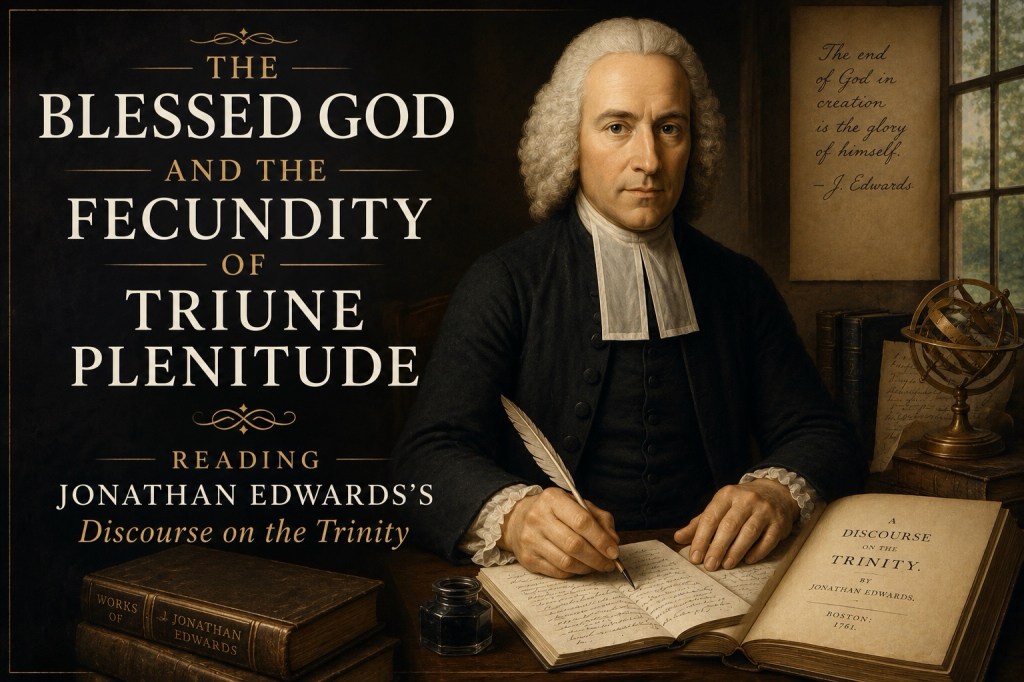
Edwards begins his discussion of the Trinity with a reflection upon God’s happiness:
“When we speak of God’s happiness, the account that we are wont to give of it is that God is infinitely happy in the enjoyment of himself, in perfectly beholding and infinitely loving, and rejoicing in, his own essence and perfections.“¹
At first glance, the statement appears conventional. The Christian tradition had long confessed that God is blessed, self-sufficient, and incapable of increase. Augustine understood God as the supreme good whose fullness grounds all creaturely blessedness. Aquinas argued that God is blessed in himself because he is his own beatitude. The Reformers likewise affirmed that God possesses within himself the fullness of every perfection and therefore depends upon nothing beyond himself. Within this broad consensus, Edwards’s opening line can seem merely traditional, a piece of theological housekeeping before he arrives at the more daring features of his Trinitarian proposal.
But I believe divine blessedness is not an introductory remark but the architectonic principle of Edwards’s argument. What if, in Edwards’ theology, the Trinity emerges as the theological explication of God’s infinite happiness? What if Edwards is not asking, “How can the triune relations explain divine blessedness?” but rather, “What must be true if the God revealed in Scripture is indeed infinitely happy in the enjoyment of himself?”
That possibility is worth considering because the biblical witness itself places surprising emphasis upon the blessedness of God. Paul refers to “the gospel of the glory of the blessed God” (1 Tim 1:11). A few chapters later, he speaks of “the blessed and only Sovereign, the King of kings and Lord of lords” (1 Tim 6:15). God is not merely the giver of blessedness. God himself is blessed. Joy, fullness, delight, and life belong eternally to God’s own being. Again and again, the biblical data insist that God lacks nothing and depends upon no one. Through the psalmist, God declares, “If I were hungry, I would not tell you, for the world and its fullness are mine” (Ps 50:12). The rhetorical force of the statement lies in its impossibility. The Creator of heaven and earth cannot stand in need of the creature. Likewise, when Paul addresses the philosophers of Athens, he proclaims that “the God who made the world and everything in it” is “not served by human hands, as though he needed anything, since he himself gives to all mankind life and breath and everything” (Acts 17:24–25). The direction of dependence always runs one way. God gives. Creatures receive.
Paul’s doxology in Romans pushes the point even further: “For from him and through him and to him are all things” (Rom 11:36). This Scriptural claim is all encompassing and should not be reduced to other philosophical affirmations of the ANE. The Spirit is giving us a summary statement of God’s aseity, fecundity, and providence. The God from whom all things come cannot derive his own fullness from anything outside himself. Before there was a world to create, before there were sinners to redeem, before there was history to govern, God already possessed the plenitude of life and joy within himself. Scripture refuses every suggestion that God’s happiness awaits completion through creation or redemption.
It is at this point that Edwards’s argument begins to unfold. If God is infinitely happy in the enjoyment of himself, then divine happiness cannot be conceived as a vague emotional state or a passive condition. Delight presupposes knowledge. One cannot rejoice in what one does not know. Therefore, Edwards reasons that God must eternally behold himself in perfect clarity. God’s knowledge of himself cannot be partial, mediated, or developing. It must be immediate, exhaustive, and wholly adequate to its object.
Thus Edwards writes:
“And accordingly it must be supposed that God perpetually and eternally has a most perfect idea of himself, as it were an exact image and representation of himself ever before him and in actual view.“²
The inferential logic deserves careful attention. Edwards says “accordingly.” The movement is deliberate. Because God is infinitely happy in the enjoyment of himself, God must eternally know himself perfectly. The Son, then, is not introduced as an isolated metaphysical datum. Rather, the Son appears as the eternal actuality of divine self-knowledge. The Father’s perfect beholding of himself subsists personally as the exact image of God.
Here the resonance with Scripture is, of course, vital. John’s Gospel opens with the declaration that “In the beginning was the Word, and the Word was with God, and the Word was God” (John 1:1). The Son eternally exists in intimate communion with the Father while fully sharing the divine identity. Later in the same prologue, John announces that “No one has ever seen God; the only begotten God, who is in the bosom of the Father, he has made him known” (John 1:18). The Son eternally knows the Father because he eternally dwells within the Father’s own life. Paul identifies Christ as “the image of the invisible God” (Col 1:15), while the author of Hebrews describes him as “the radiance of the glory of God and the exact imprint of his nature” (Heb 1:3). Edwards’s language of exact image and representation is not identical to the biblical vocabulary, but it is difficult to deny that he is attempting to think through what these biblical affirmations entail. If the Son is indeed the exact imprint of God’s nature and the perfect image of the invisible God, then divine self-knowledge belongs eternally to the life of God.
Yet Edwards’s argument does not stop with knowledge. God’s infinite happiness also involves delight. The God who perfectly beholds infinite beauty must also perfectly rejoice in infinite beauty. Divine blessedness includes not only the vision of God’s own excellence but also God’s infinite love for that excellence. Edwards therefore continues: “And from hence arises a most pure and perfect energy in the Godhead, which is the divine love, complacence and joy.“³
Again, the transition matters. “From hence.” Divine joy is not an afterthought. The Spirit enters the argument through the reality of God’s delight in himself. The Spirit is not reduced to an impersonal force or emotional quality. Rather, the Spirit is presented as the subsisting actuality of divine love and joy, the living delight of God in God.
Once more, the biblical data provide the theological contours for Edwards’s reflection. Paul teaches that “the Spirit searches everything, even the depths of God” (1 Cor 2:10). The Spirit uniquely knows God because the Spirit is fully divine. Elsewhere, the Spirit is associated repeatedly with the communication of divine love and joy. “God’s love has been poured into our hearts through the Holy Spirit who has been given to us” (Rom 5:5). The kingdom of God consists in “righteousness and peace and joy in the Holy Spirit” (Rom 14:17). The fruit produced by the Spirit includes “love” and “joy” (Gal 5:22). Edwards’s synthesis moves beyond the explicit wording of these texts, but it arises from sustained reflection upon their theological implications.
At this point, the larger significance of Edwards’s argument begins to emerge. Contemporary theology often struggles to hold together truths that classical theology regarded as mutually reinforcing. On the one hand, theologians rightly insist upon divine aseity. God depends upon nothing beyond himself. Yet this insistence can subtly transform divine perfection into a kind of sterile self-containment, as though God’s fullness excludes fecundity. On the other hand, modern accounts of divine relationality sometimes secure God’s generosity by introducing some form of divine lack. God creates because God requires relationship, seeks fulfillment, or needs an object for love. The God of Israel is not needy. He is not lonely. He is not waiting for the world to become fully himself. Yet neither is he inert. The biblical God rejoices, delights, loves, gives, blesses, and communicates life. He is the blessed God.
Edwards’s reflections suggest that these truths belong together. Divine plenitude is the ground of fecundity. Because God is infinitely happy in himself, he is capable of giving without depletion. Because God lacks nothing, he can bestow everything freely. Creation does not remedy a deficiency within God. Redemption does not complete an unfinished divine life. The communication of goodness in creation and salvation arises from abundance rather than necessity.
This insight carries profound implications for Christian theology. It preserves divine aseity because God’s happiness depends upon nothing outside himself. It safeguards divine impassibility because God’s blessedness cannot be diminished or supplemented by creaturely realities. It secures the gratuity of creation because God creates from fullness rather than need. It enriches the doctrine of salvation because participation in God’s life becomes the gracious sharing of a blessedness already complete in itself.
Perhaps this is why Edwards begins where he does. The opening sentence of the Discourse on the Trinity is not a mere piece of beautiful theological profundity. This is Edward’s’ doorway into the mystery of God’s life. The Father eternally beholds himself in the Son. The Father eternally delights in himself in the Spirit. Before the first word of creation was spoken, before the first covenant promise was given, before the Lamb was slain from the foundation of the world, God possessed within himself inexhaustible life, joy, and delight.
The gospel, then, is not the story of a deficient deity seeking fulfillment through history. It is the story of the blessed God communicating the abundance of his own life. Grace is not compensation for divine lack. It is the overflow of plenitude. The God who calls sinners into fellowship with himself does not invite them into an emptiness waiting to be filled. He invites them into the eternal joy of Father, Son, and Holy Spirit.
Perhaps theology proper should begin where Edwards began. “When we speak of God’s happiness…” For if the triune God is indeed the blessed God, then divine blessedness is not merely one perfection among others. It is the theological horizon within which God’s fullness, generosity, and self-communication become intelligible. The beginning of theology is not scarcity. It is joy.
¹ Jonathan Edwards, Writings on the Trinity, Grace, and Faith, ed. Sang Hyun Lee and Harry S. Stout, vol. 21 of The Works of Jonathan Edwards (New Haven: Yale University Press, 2003), 113.
² Edwards, Writings on the Trinity, Grace, and Faith, 113.
³ Edwards, Writings on the Trinity, Grace, and Faith, 113.
Further reading on Triune fullness: Visit the Divine Blessedness study pathway and the free Knowing the Blessed God biblical guide.
Continue Reading
Divine Blessedness Library · Free Seven-Part Biblical Guide · Subscribe to Donnie’s Dogmatics

Leave a Reply