
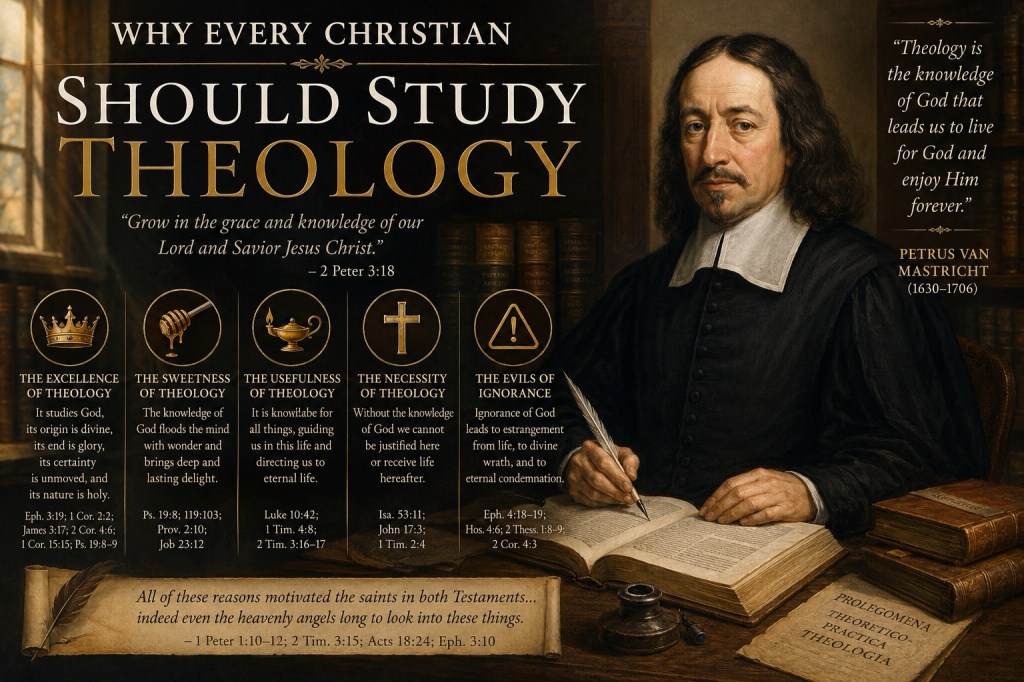
It seems many Christians assume theology belongs to church leaders, professors, and (maybe forced upon) students. However, I believe it is important to remember that the Christian life begins with the knowledge of God and grows through the knowledge of God. This is theology. Sometimes theology gets a bad reputation and sometimes people don’t like theology because they have ideas which do not fit with either Scripture or fundamental accepted interpretation of Scripture.
God would have us all be theologians. he wants us all to know him, love him, and serve him. This is theology. Eternal life itself, Jesus says, consists in knowing “the only true God, and Jesus Christ whom you have sent” (John 17:3). Peter urges believers to “grow in the grace and knowledge of our Lord and Savior Jesus Christ” (2 Pet. 3:18). Paul prays that Christians would be filled “with the knowledge of his will in all spiritual wisdom and understanding” (Col. 1:9). Theology, therefore, is not a luxury for a few gifted Christians. It is the calling of every Christian. To study theology is simply to seek a deeper knowledge of the God who has revealed himself in Scripture and in his Son.
The seventeenth-century theologian Petrus van Mastricht understood this need for theology that is intellectual and practical very well. His goal is to produce “the doctrine of living for God through Christ” (1:63). In his Prolegomena, he offers several reasons why every believer should devote himself to the study of theology. His arguments remain as compelling today as they were three centuries ago.¹ Let’s examine them.
The Excellence of Theology
The first reason is the excellence of theology itself. Every discipline studies something important. History studies the past. Medicine studies the body. Law studies justice. Astronomy studies the heavens. Yet theology surpasses them all because it studies God.
Paul speaks of “the unsearchable riches of Christ” (Eph. 3:8) and prays that believers would know “the love of Christ that surpasses knowledge” (Eph. 3:19). He even declares that he resolved to know nothing among the Corinthians except “Jesus Christ and him crucified” (1 Cor. 2:2). In Philippians he goes further, describing “the surpassing worth of knowing Christ Jesus my Lord,” compared to which every earthly achievement appears as loss (Phil. 3:8).
Mastricht argues that theology derives its excellence first from its divine origin. It is not human speculation about ultimate reality. It is revelation. James calls it “the wisdom from above” (James 3:17). Paul reminds us that the light of the gospel shines because God himself has caused light to shine into human hearts (2 Cor. 4:6). Theology begins not with human discovery but with divine self-disclosure.²
Its excellence also arises from its subject matter. Theology concerns the triune God, his eternal purposes, the person and work of Christ, the Spirit’s saving ministry, and the glory of God’s kingdom. No subject can be greater because no subject can be higher than God himself.
Finally, theology is excellent because of its end. Its purpose is not merely intellectual mastery. It teaches us how to live before God, worship God, glorify God, and enjoy God forever. It directs every area of life toward its proper goal.
The Sweetness of Theology
Many people assume theology is dry. Scripture repeatedly says the opposite. The psalmist declares that God’s testimonies are “the rejoicing of my heart” (Ps. 119:111). He says God’s words are “sweeter than honey to my mouth” (Ps. 119:103). Jeremiah confesses, “Your words were found, and I ate them, and your words became to me a joy and the delight of my heart” (Jer. 15:16).
Why is theology so delightful? Because theology brings us into contact with the highest and most beautiful reality in existence. Human beings were created for God. Augustine famously observed, “You have made us for yourself, and our heart is restless until it rests in you.” The mind was created to know God. The affections were created to delight in God. The will was created to obey God. For this reason, genuine theological understanding never ends in mere information. It leads to admiration, worship, joy, and wonder.
Mastricht argues that theology’s sweetness arises both from the excellence of its object and from the certainty of its truth.³ There is profound delight in knowing not merely what is beautiful but what is certainly true.
The Usefulness of Theology
Modern people often judge everything by usefulness. If something does not produce immediate practical results, it is considered unimportant. Yet theology is the most practical discipline in existence. Paul writes that Scripture is profitable “for teaching, for reproof, for correction, and for training in righteousness” (2 Tim. 3:16). He teaches that godliness is “of value in every way, as it holds promise for the present life and also for the life to come” (1 Tim. 4:8).
Theology teaches us how to pray when suffering comes. It teaches us how to worship when blessings abound. It teaches us how to understand temptation, repentance, forgiveness, suffering, death, and hope. It teaches husbands how to love their wives, parents how to raise their children, churches how to worship, and believers how to endure trials.
Theology explains not only how to live but why we should live. Mastricht therefore concludes that theology is, in a sense, the one thing necessary because it directs all other things toward their proper end.⁴ Without God at the center, every other pursuit ultimately loses its meaning.
The Necessity of Theology
The usefulness of theology is great. Its necessity is even greater. Isaiah writes that God’s righteous servant will justify many “by his knowledge” (Isa. 53:11). Jesus declares that eternal life consists in knowing the Father and the Son (John 17:3). Paul says that people are saved through the knowledge of the truth (1 Tim. 2:4).
This does not mean that salvation depends upon possessing advanced theological education. The thief on the cross knew far less than the apostles. Yet he truly knew Christ. The point is that Christianity is inseparable from the knowledge of God. There can be no trust in a God who is unknown. There can be no worship of a God who is unknown. There can be no communion with a God who is unknown.
Every Christian grows in holiness by growing in the knowledge of God. This is why Paul continually prays for the churches to increase in spiritual understanding (Eph. 1:17-19; Col. 1:9-10). Growth in theology and growth in godliness belong together because theology is the knowledge of the God who sanctifies his people.
The Danger of Ignorance
Scripture speaks not only of the blessings of knowing God but also of the dangers of not knowing him. Paul describes unbelievers as “darkened in their understanding, alienated from the life of God because of the ignorance that is in them” (Eph. 4:18). Hosea records God’s solemn indictment: “My people are destroyed for lack of knowledge” (Hos. 4:6). Paul teaches that final judgment will come upon those “who do not know God” (2 Thess. 1:8).
The greatest human problem is not lack of information but lack of the knowledge of God. We live in an age overflowing with information. We carry more information in our pockets than previous generations could access in a lifetime. Yet information alone cannot save. Information alone cannot produce wisdom. Information alone cannot reconcile sinners to God.
Only the knowledge of God revealed in Jesus Christ can accomplish that. Mastricht warns that ignorance of theology leaves people estranged from the covenant of grace, vulnerable to error, and exposed to divine judgment.⁵ His warning remains urgently relevant in every generation.
Following the Saints
One of Mastricht’s most beautiful observations is that the study of theology characterizes all the people of God. The prophets searched and inquired carefully concerning the salvation that was to come (1 Pet. 1:10-11). The apostles devoted themselves to the ministry of the Word (Acts 6:4). Timothy was instructed from childhood in the sacred writings (2 Tim. 3:15). Even the angels long to look into the mysteries of redemption (1 Pet. 1:12).
From Abraham to Moses, from David to Isaiah, from Peter to Paul, the people of God have always sought to know God more deeply. Theology is not an academic hobby. It is the lifelong vocation of God’s people.
The Greatest Reason of All
Ultimately, Christians study theology for the same reason children want to know their father, friends want to know one another, and lovers desire deeper communion. We study theology because we love God.
The goal of theology is communion with God. Theology begins with revelation, leads to worship, deepens obedience, strengthens hope, and culminates in the beatific vision when faith gives way to sight.
Every page of Scripture calls us toward this goal of knowing God. “Let not the wise man boast in his wisdom,” says the Lord, “but let him who boasts boast in this, that he understands and knows me” (Jer. 9:23-24). There is no greater privilege. There is no greater pursuit. There is no greater study than the knowledge of the living and triune God.
Notes
- Petrus van Mastricht, Theoretical-Practical Theology, vol. 1, Prolegomena, ed. Joel R. Beeke, trans. Todd M. Rester (Grand Rapids: Reformation Heritage Books, 2018), 90-92.
- Mastricht, Theoretical-Practical Theology, 90.
- Mastricht, Theoretical-Practical Theology, 91.
- Mastricht, Theoretical-Practical Theology, 91.
- Mastricht, Theoretical-Practical Theology, 91-92.

Leave a Reply