Christ’s cross did not arrive at Calvary without preparation. Before Christ was crucified outside Jerusalem, God was training his people to understand his eternal plan for what would happen on that Friday afternoon. God prepared his people through images of blood, through priests, through altars, through the repeated and irreversible death of innocent animals in the place of guilty people. He did it through the words of prophets like those recorded in Isaiah 53.
By the time Jesus died, the theological categories were already in place. The New Testament writers did not invent a theory of the cross. They recognized the fulfillment of the Triune God’s eternal purpose as it had been revealed throughout history. This article will show how the Old Testament sacrificial system establishes the theological categories of substitution, judgment, purification, and covenant reconciliation that culminate definitively in Christ’s death.
Why So Much Blood?
Any serious reader of the Old Testament eventually confronts the same unsettling question: Why so much blood? From the opening chapters of Genesis onward, sacrificial death stands near the center of the biblical story. Adam and Eve’s nakedness, the visible sign of their guilt and shame, is covered only after the death of an animal (Gen 3:21). By the time one reaches Leviticus, the imagery becomes relentless. Animals are slaughtered daily. Blood is poured out, sprinkled, and applied to the altar. The Day of Atonement culminates in solemn rites involving two goats, one slain before the Lord and the other sent into the wilderness carrying away the sins of the people (Lev 16). Modern readers often recoil from the severity of it all. Yet the question cannot simply be dismissed: Why does reconciliation with God unfold through sacrificial death?
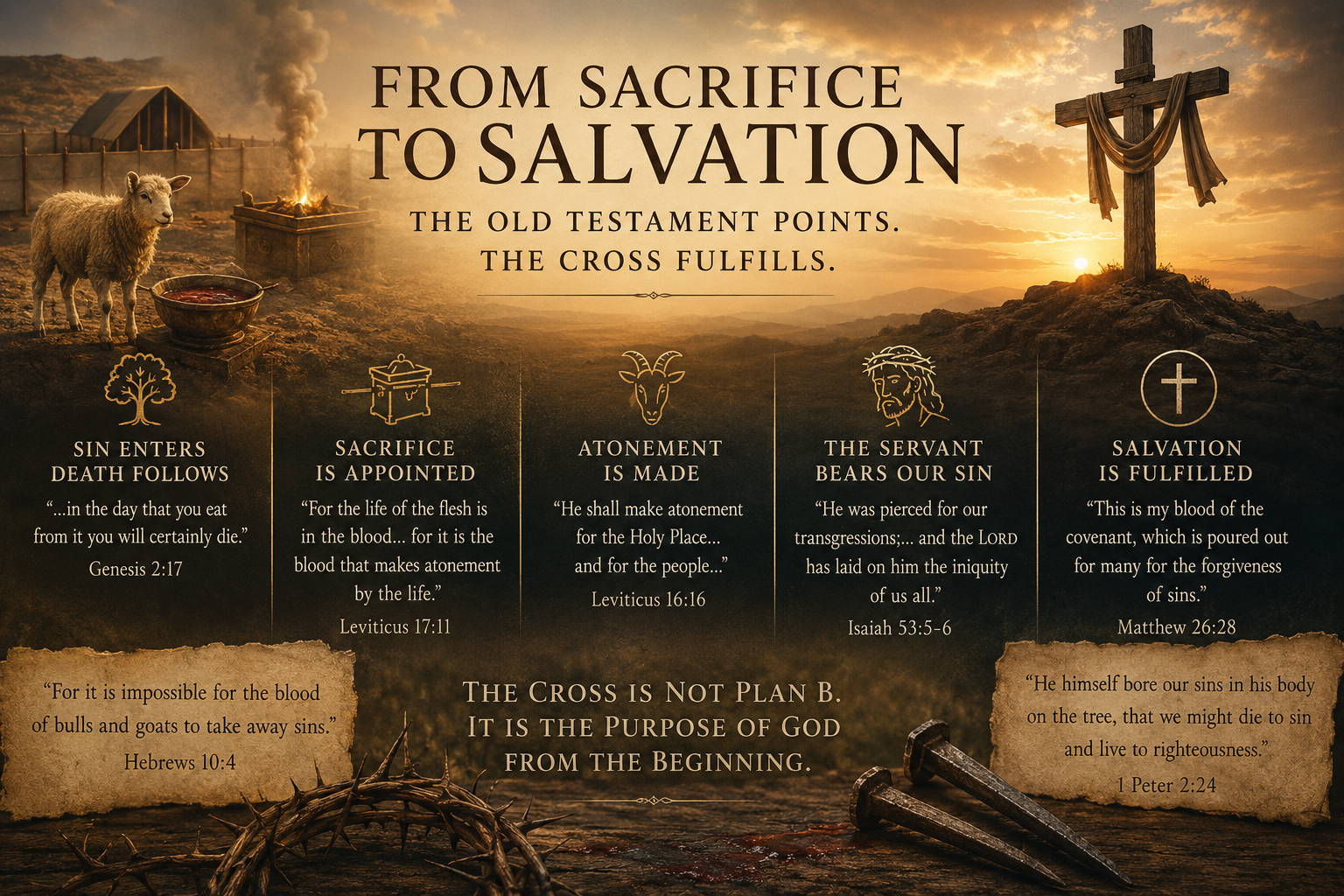
The answer is rooted in the opening chapters of Scripture itself. Before there is Israel, tabernacle, priesthood, or sacrifice, there is the divine warning given in Eden: “in the day that you eat from it you will certainly die” (Gen 2:17). Sin and death are joined together from the beginning. Death is not an arbitrary penalty later attached to sin. It is the fitting judicial consequence of rebellion against the living God. The sacrificial system does not invent this connection between sin and death. It dramatizes it before Israel continually and publicly. Every sacrifice declares the same terrible truth: sin forfeits life.
Leviticus 17:11 provides the theological heart of the sacrificial system: “For the life of the flesh is in the blood, and I have given it to you on the altar to make atonement for your souls; for blood by reason of the life makes atonement” (Lev 17:11). God himself speaks as the giver of the sacrificial provision: “I have given it to you.” The sacrificial system is therefore not humanity attempting to manipulate a reluctant deity through ritual violence. The initiative belongs to God. Within the covenant, he appoints a means by which guilty sinners may approach him without being consumed by his holiness. The blood atones because the blood represents life given over in death. Modern discussions sometimes emphasize only the positive symbolism of life, but Leviticus refuses to separate blood from violent sacrificial death. The life-bearing blood exists upon the altar because death has taken place. A substitute has died in the place of another. The animal forfeits its life because sin deserves death. Through substitutionary death, atonement is made and forgiveness is granted within the covenantal order established by God.
The Day of Atonement gathers these themes into a single dramatic ritual. One goat is slain, its blood brought into the Holy of Holies. The other bears the confessed sins of Israel and is driven into the wilderness, symbolically carrying away the guilt of the people (Lev 16:20-22). Death and removal. Judgment endured and sin carried away. Together the two goats form a living prophecy of what Christ would accomplish fully and finally at the cross.
Many modern readers resist this sacrificial logic because it confronts us with the gravity and cost of sin and the holiness of God. Still, the Bible does not present these rites as primitive religious excesses to be outgrown. These are divine instructions. The sacrificial order reveals how seriously God regards sin and how graciously he provides a way for sinners to dwell in covenant fellowship with him. One may struggle emotionally with the category of substitutionary sacrifice, but the biblical data does not permit us to dismiss it without dismissing the theological structure of the canon itself. The pattern is God’s own. And in the fullness of time, it leads directly to Christ.
The Sin Offering in Leviticus 4
Leviticus 4 deserves close attention because it spells out the inner logic of sacrifice with unusual clarity. A worshiper brings a sacrificial animal before the Lord (Lev 4:3-4). Then comes the act that makes the theological structure visible: “He shall lay his hand on the head of the bull and kill the bull before the LORD” (Lev 4:4).
The laying on of hands is not ceremonial decoration. Throughout the sacrificial system this gesture signifies a covenantal transfer. The worshiper identifies with the animal. The animal now stands in representative connection to the worshiper’s guilt. What follows is its death. Then the priest makes atonement. Then comes the result: “Thus the priest shall make atonement for them, and they shall be forgiven” (Lev 4:20). The sequence is theologically important. The guilt leads to sacrifice which leads to priestly mediation which leads to atonement which leads to forgiveness. Remove any element and the system collapses. Forgiveness does not hover in midair as a sheer act of divine will. It is covenantally grounded in the death of a substitute. Couldn’t God just forgive sins without any act bringing justice?? That is a great question, but the reality is that he did not.
The Day of Atonement
Leviticus 16 presents the most concentrated exposition of Israel’s atonement theology. Once a year the high priest enters the holy of holies, in which the presence of God was manifested in a special way, with blood. He comes as the representative of the entire people of Israel. Two goats capture the two dimensions of what must be accomplished.
The first goat is slaughtered as the sin offering, and its blood is carried by the high priest beyond the veil into the Holy of Holies. There, before the immediate presence of the covenant Lord, the blood is sprinkled upon and before the mercy seat, the kappōret, the golden covering of the ark of the covenant. This is the theological center of the Day of Atonement ritual because this is where Israel’s uncleanness encounters the holiness of God.
The kappōret is the appointed place of divine enthronement and covenant meeting. The Lord had declared, “There I will meet with you” (Exod 25:22). Yet the same divine presence that gives life also threatens judgment against impurity and rebellion. Israel’s sin has not remained outside the sanctuary. Human uncleanness symbolically contaminates the holy dwelling place of God himself (Lev 16:16). Thus atonement must occur at the very center of the sanctuary where divine holiness dwells.
The presentation of blood before the mercy seat accomplishes several interconnected purposes. First, it fulfills the covenantal demand that sin results in death. Blood signifies life given up under judgment. As Leviticus 17:11 explains, God gives the blood upon the altar “to make atonement” because “the life of the flesh is in the blood.” Sin is not ignored or minimized. Judgment truly falls.
Second, the blood purifies the sanctuary from the accumulated defilement of Israel’s sins and uncleanness. Leviticus presents atonement not merely as forgiveness of guilt but also as cleansing from pollution. The sanctuary itself must be purified so that the holy God may continue to dwell among his covenant people without consuming them in judgment.
Third, the ritual preserves covenant communion between God and Israel. The Day of Atonement is fundamentally about maintaining the possibility of divine presence among a sinful people. Through sacrificial blood, the breach created by sin is addressed according to God’s own appointed means. The holy God remains in the midst of Israel not because holiness has been relaxed, but because atonement has been made.
The climax of the ritual therefore occurs when the high priest stands before the mercy seat with sacrificial blood. Everything in Leviticus 16 moves toward this moment. Beyond the veil, in the place no ordinary Israelite could enter, judgment and mercy meet together. The sanctuary is cleansed, covenant fellowship is preserved, and Israel learns anew that life with the holy God is possible only through atoning blood.
The second goat, often called the scapegoat, embodies a different yet inseparable dimension of atonement. Unlike the first goat, this animal is not slain before the Lord. Instead, the high priest lays both hands upon its head and confesses over it “all the iniquities of the people of Israel, and all their transgressions, all their sins” (Lev 16:21). Through this symbolic act, the accumulated guilt and uncleanness of the nation are placed upon the living goat, which is then led away into the wilderness, far from the camp and far from the holy presence of God.
The imagery is powerful and unsettling. Israel watches its sins depart into the desolate place beyond the boundaries of covenant life. The wilderness in the Old Testament is not morally neutral space. It is the realm of curse, uncleanness, danger, and separation. The scapegoat bears the sins of the people away from the sanctuary and away from the community of the redeemed. Their transgressions are removed from them. The pollution that threatened the covenant relationship is carried off into abandonment and exile.
This ritual movement complements the sacrifice of the first goat. The slain goat addresses the problem of divine holiness through sacrificial blood brought before the mercy seat. The scapegoat addresses the problem of human defilement and guilt through the removal of sin from the people. One goat dies before the presence of God; the other departs bearing sin away into the wilderness. Together the two goats constitute a single sin offering (Lev 16:5), revealing two inseparable dimensions of atonement: satisfaction and removal, purification and expulsion, reconciliation and cleansing.
The Old Testament ritual separates these actions into two symbolic movements, but the cross gathers them together in the one work of Christ. At Calvary, Christ both bears divine judgment against sin and removes sin from his people entirely. He dies as the sacrificial substitute before God, and he carries away the guilt and uncleanness of his people “as far as the east is from the west” (Ps 103:12). The cross therefore fulfills in substance what the two goats could only portray through symbol and repetition.
The drama of Leviticus 16 ultimately presses toward this astonishing reality: sin must not merely be forgiven. It must be judged, cleansed, removed, and carried away from the presence of the holy God and from the people who belong to him.
Isaiah 53: The Prophetic Climax
Isaiah 53 stands as one of the Old Testament’s exposition of substitutionary, sin-bearing suffering. It is not peripheral background material later pressed into Christian service. It is the prophetic foundation upon which the New Testament interpretation of the cross is constructed. Jesus applies the chapter to himself in Luke 22:37. Philip proclaims it as the heart of the gospel in Acts 8:35. Paul’s theology of atonement breathes its language and logic at nearly every point.
The chapter begins by establishing the Servant’s innocence with striking clarity. “He had done no violence, and there was no deceit in his mouth” (Isa 53:9). That detail is not ornamental. It is the theological precondition for substitution. A guilty sufferer may endure judgment for his own sin, but he cannot stand in the place of others. The logic of atonement requires a righteous substitute. Isaiah then unfolds the Servant’s suffering in language saturated with vicarious and penal significance:
“Surely he has borne our griefs
and carried our sorrows;
yet we esteemed him stricken,
smitten by God, and afflicted.
But he was pierced for our transgressions;
he was crushed for our iniquities;
upon him was the chastisement that brought us peace,
and with his wounds we are healed.
All we like sheep have gone astray;
we have turned every one to his own way;
and the LORD has laid on him
the iniquity of us all” (Isa 53:4-6).
The force of the passage lies in its relentless transfer language. He bears what belongs to others. He is pierced because of our transgressions and crushed because of our iniquities. The punishment falls on him so that peace might belong to us. Isaiah does not present suffering as mere solidarity with human pain, nor simply as the tragic consequence of human hatred. The Servant suffers under the divine judgment due to the sins of others.
The climax comes in the final line of verse 6: “the LORD has laid on him the iniquity of us all.” Yahweh himself is the acting subject. The suffering of the Servant is therefore neither accidental nor merely political. It is judicial and divinely ordained. God places upon the Servant the guilt of the many. That judicial dimension intensifies further in Isaiah 53:10:
“Yet it was the will of the LORD to crush him;
he has put him to grief;
when his soul makes an offering for guilt,
he shall see his offspring;
he shall prolong his days.”
The phrase “offering for guilt” translates the Hebrew term אָשָׁם (ʾāšām), the technical Levitical designation for the guilt offering (Lev 5:6, 15, 18; 7:1-7). Isaiah is not reaching for vague sacrificial imagery. He deliberately places the Servant within the liturgical and judicial framework of Israel’s sacrificial system. The Servant is the guilt offering. He bears guilt not his own. He stands beneath judgment so that others may stand acquitted.
The result is explicitly forensic: “the righteous one, my servant, shall make many to be accounted righteous, and he shall bear their iniquities” (Isa 53:11). Justification comes through substitutionary sin-bearing. The righteous Servant bears the iniquities of the guilty so that the guilty may be reckoned righteous before God. The doctrine of substitutionary atonement is therefore not a late theological construction imposed upon Scripture. It is woven into the texture of Isaiah’s prophecy centuries before Golgotha. The cross does not invent this pattern. It fulfills it.
From Shadow to Substance
The sacrificial system of the Old Testament was never designed to stand forever. Hebrews states this with unmistakable force: “For it is impossible for the blood of bulls and goats to take away sins” (Heb 10:4). The sacrifices of the old covenant were neither empty rituals nor divine theater. God himself instituted them. Within the covenantal structure of Israel’s worship, they truly provided ceremonial atonement and maintained covenant fellowship. Yet their very repetition testified to their incompleteness. They pointed beyond themselves toward a greater and final sacrifice still to come.
When Christ comes, he interprets his own death through this sacrificial and covenantal framework. At the Last Supper, taking the cup, he declares: “for this is My blood of the covenant, which is being poured out for many for forgiveness of sins” (Matt 26:28). Every phrase is heavy with Old Testament resonance. “Blood of the covenant” recalls Exodus 24, where Moses sprinkles covenant blood upon the people to ratify Israel’s communion with God (Exod 24:8). “Poured out for many” echoes the language of Isaiah 53, where the Servant bears the sins of the many and pours out his life unto death (Isa 53:11-12). “For forgiveness of sins” identifies the purpose of Christ’s death with unmistakable clarity.
Jesus is not adopting a foreign interpretive grid later imposed by the church. He understands his death through the categories Israel’s Scriptures had already established. The sacrificial system had prepared Israel to see that sin demands judgment, that atonement requires blood, and that reconciliation with God comes through substitutionary sacrifice. The Old Testament did not merely predict the cross. The Old Testament interpreted the meaning of the cross in advance. God demonstrated shame and guilt must be covered with sacrifice. Leviticus taught Israel that sin requires sacrificial death before a holy God. Isaiah taught Israel that a righteous Servant would bear the guilt of the many. The Psalms gave language for the suffering of the innocent righteous one. When the apostles proclaim that Christ died “for our sins” (1 Cor 15:3), they are not inventing a new theology after the resurrection. They are drawing together lines already written across the whole canon of Israel’s Scripture.
Calvary, then, is not a theological interruption or divine improvisation. It is the fulfillment toward which the entire sacrificial order had been moving from the beginning. The blood of bulls and goats created expectation. The Servant songs created anticipation. The covenant sacrifices created longing. In Christ, the shadows give way to substance. The question the sacrificial world of the Old Testament kept asking finally receives its answer in the crucified Son of God.
Conclusion
The argument of this essay has been that the doctrine of substitutionary atonement is not a late theological invention imposed upon the Bible, but the theological logic woven through the fabric of Scripture itself. From Eden onward, the biblical narrative joins sin and death together. The sacrificial system of Israel did not create that reality. It revealed it publicly, ritually, and covenantally before the people of God. Leviticus taught Israel that guilt requires atonement, that holiness cannot simply ignore uncleanness, and that reconciliation with God comes through divinely appointed sacrifice. The Day of Atonement gathered those truths into a single liturgical drama of judgment, cleansing, and removal. Isaiah 53 then gave prophetic voice to what the sacrifices could only symbolize: a righteous Servant who would bear the sins of the many and make them righteous through his own suffering.
When the New Testament proclaims that Christ died “for our sins,” it is therefore not inventing a new interpretation of the cross after the fact. It is recognizing that the patterns, categories, and expectations established throughout the Old Testament have reached their fulfillment in Jesus Christ. The sacrificial system pointed beyond itself. The blood of bulls and goats could cleanse ceremonially, but it could not finally remove sin. The shadows awaited the substance. In Christ, the true sacrifice arrives. He is simultaneously priest, offering, substitute, and sin-bearer. He enters not an earthly sanctuary made with hands, but the heavenly holy place through his own blood, securing eternal redemption for his people.
The cross, then, stands at the center of Scripture because it stands at the center of God’s redemptive purpose. At Calvary, divine justice is not abandoned but satisfied. Sin is not minimized but judged. Mercy is not sentimentalized but purchased through sacrificial death. The holiness that once threatened exile now becomes the ground of reconciliation because the Son has borne the judgment sinners deserved. The same God who declared in Eden, “you shall surely die,” is the God who, in Christ, bears death himself so that his people might live.
This is why the Old Testament is so saturated with sacrifice, blood, priesthood, and atonement. Those realities were never ends in themselves. They were preparing the world for the Lamb of God who takes away the sin of the world (John 1:29). The whole sacrificial order was a long prophetic ache moving toward Golgotha. And at the cross, the question raised across centuries of altar fires and flowing blood finally receives its answer.

Leave a Reply