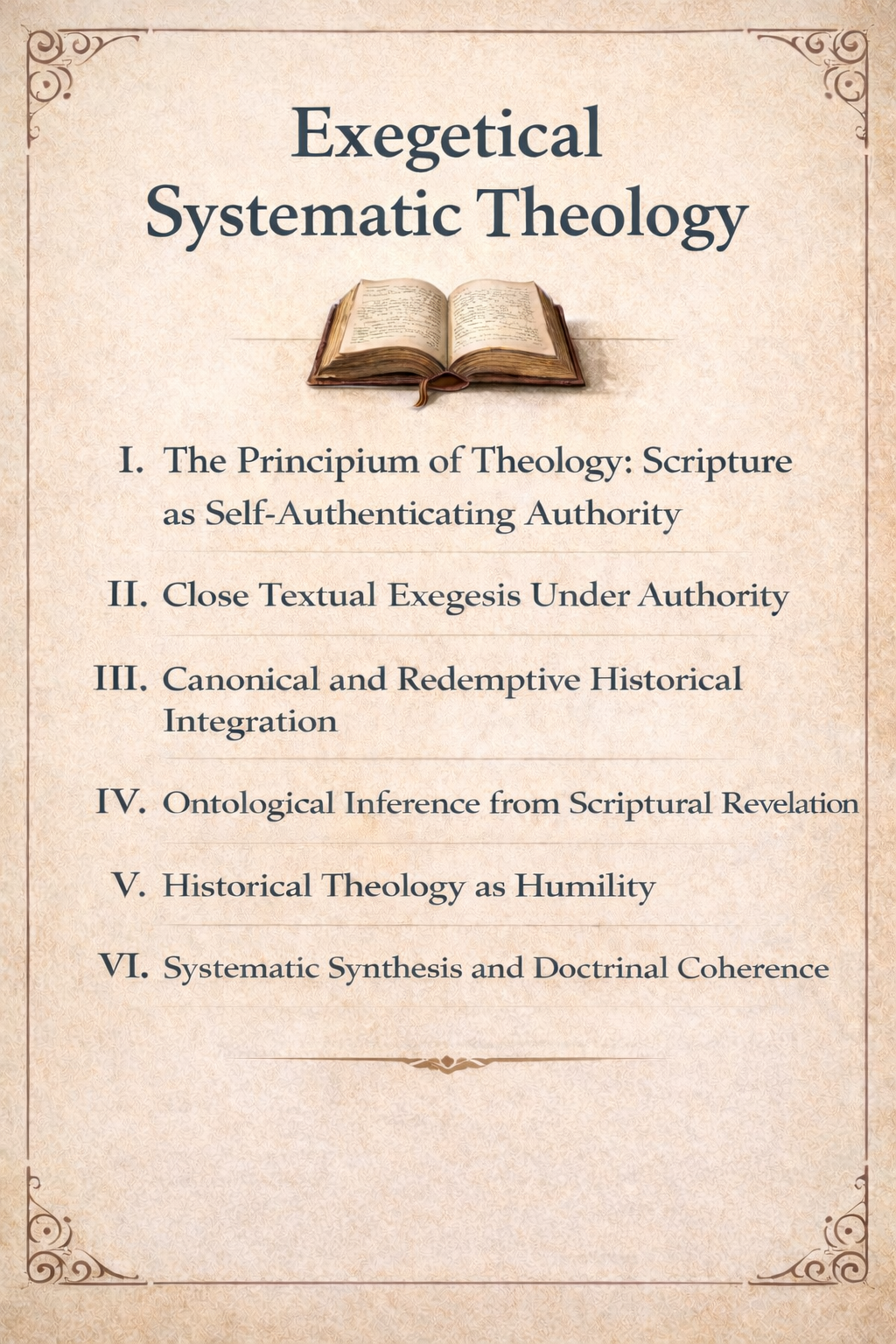
Introduction: Recovering the Order of Theology
Christian theology has always required method even if it is not acknowledged . From the patristic era onward, the church has wrestled with the relationship between Scripture and doctrinal formulation. Yet in modern theological practice, the disciplines have frequently drifted apart.
In the early centuries, doctrinal controversies were exegetical disputes. Athanasius grounded his defense of the Son’s consubstantiality in the exegesis of texts such as John 1:1 and Proverbs 8. Augustine’s Trinitarian reflections arose from sustained meditation on Scripture. Exegesis and ontology were intertwined. The church’s creeds were not speculative additions but disciplined confessions of biblical teaching. Medieval scholasticism refined theological distinctions with remarkable precision. Thomas Aquinas, for example, distinguished essence and relation to preserve Trinitarian coherence. While Scripture remained foundational, theological reasoning at times developed in increasingly conceptual terms.
The Reformation reasserted the primacy of Scripture as the principium of theology. The Reformers insisted that doctrine must arise from and remain accountable to the Word. Yet they also produced systematic confessions and catechisms. Biblical exegesis and doctrinal ordering were again joined.
Modern theology introduced new fractures. Historical criticism and academic divisions derived from liberal German theological universities often isolated texts from canonical unity. Biblical theology and systematics began to be treated as separate enterprises. In many contexts, theological reflection became anthropocentric, with experience or culture functioning as organizing principles. The result has been methodological instability. Exegetical rigor is sometimes detached from systematic coherence. Systematic proposals are sometimes insufficiently grounded in careful textual work.
This article contends that theology requires renewed methodological integration. The proposed model, exegetical systematic theology, seeks to reunite exegesis and systematics under the principial authority of Scripture.
I. The Principium of Theology: Scripture as Self Authenticating Authority
The first and non-negotiable claim is this: Holy Scripture is the principium unicum of theology. Herman Bavinck states it with clarity: “Holy Scripture is the principium unicum of theology. It alone is the source from which theology draws its material and the norm by which it is judged. Scripture is not merely a means through which God once revealed himself, but the permanent, objective, and sufficient rule of faith for the church in all ages. For that reason Scripture is αὐτόπιστος, self authenticating. It does not derive its authority from the church, but carries that authority in itself as the Word of God. The church does not stand above Scripture, but under it. The authority of Scripture is not founded upon the testimony of the church, but upon God himself who speaks in it” (Herman Bavinck, Reformed Dogmatics, 1:II).
This claim is drawn from Scripture’s own testimony. “The law of the LORD is perfect” (Ps 19:7). “The sum of your word is truth” (Ps 119:160). “Scripture cannot be broken” (John 10:35). “All Scripture is breathed out by God” (2 Tim 3:16). The Word is living and active (Heb 4:12). Scripture is therefore not a historical record of past revelation alone. It is the present voice of God to his church. It carries its authority because God speaks in it. The church receives, confesses, and transmits this Word, but does not ground its authority. This conviction establishes posture. Theology begins in submission. The interpreter stands under the Word, not over it.
II. Stage One: Close Textual Exegesis Under Authority
Because Scripture is the principium, theology must begin with careful exegesis.
- Textual Establishment: Theologians must attend to the stability of the text. Where textual variants materially affect meaning, they must be weighed responsibly. Theological claims cannot rest on unstable readings.
- Grammatical and Lexical Analysis : Words must be read in context. Syntax shapes meaning. Verbal forms carry aspect and force. Terms such as “glory” (doxa), “life” (zoē), and “righteousness” (dikaiosynē) must be interpreted within their literary setting before they are carried into systematic categories.
- Discourse Analysis: Meaning is structured argument. Paragraphs have controlling claims. Repetition signals emphasis. Contrast sharpens theology. The shape of discourse reveals authorial intent.
For example, Paul’s doxology in Romans 11:33 follows sustained doctrinal reasoning. Its placement is not accidental. It marks the culmination of argument. The text itself teaches that doctrine presses toward worship. At the conclusion of this stage, one possesses bounded claims. One knows what this passage says within its own argument. One does not yet claim more.
III. Stage Two: Canonical and Redemptive Historical Integration
The God who speaks in one text speaks in the whole of Scripture. Scripture is not a loose anthology of religious insight. Rather, Scripture is a unified divine discourse unfolding across history. The voice that addresses Moses from the bush is not silenced when the Gospel writers take up their pens. It is the same Lord.
Exegetical theology must therefore learn to hear Scripture as a whole. This requires disciplined tracing of canonical resonance. Intertextual echoes must be identified with care. Repeated phrases, covenantal formulas, typological patterns, and theological themes form connective tissue across the canon. For example, the promise “I will be your God, and you shall be my people” runs from Genesis 17 through Jeremiah 31 and culminates in Revelation 21:3. The covenant Lord remains the same, though the historical administration unfolds in stages.
The covenantal structure of Scripture must therefore shape interpretation. Law, promise, fulfillment, and consummation are not interchangeable categories. Each text stands somewhere within that ordered history. To read a promise without regard for its fulfillment, or a fulfillment without regard for its promise, distorts both. This step guards against what might be called local absolutism. A single passage cannot be elevated into a controlling doctrine if it conflicts with the broader canonical witness. Scripture interprets Scripture. Clearer texts illumine less explicit ones. Later revelation clarifies earlier forms without canceling them.
Progressive revelation must also be respected. Revelation unfolds in time, yet it does not revise God’s identity. The New Testament does not introduce a different God. It reveals more fully the God who has always been. Christ does not abolish the law and the prophets but fulfills them (Matt 5:17). Fulfillment intensifies meaning rather than dissolving it. The seed becomes the tree; it does not cease to be what it was.
Canonical reading is not optional enrichment. It is theological necessity. Because the author of Scripture is one, the meaning of Scripture is coherent. Because God is faithful, his self revelation is consistent. Exegetical theology must therefore move from the particular to the whole and back again, allowing the unity of the canon to discipline every local claim.
IV. Stage Three: Ontological Inference from Scriptural Revelation
The God who speaks in one text speaks in the whole canon. This claim is not a slogan. It is a theological necessity grounded in the identity of God himself. If God is simple, faithful, and unchanging, then his speech will bear the marks of unity and coherence. “God is not a man, that he should lie” (Num 23:19). “Jesus Christ is the same yesterday and today and forever” (Heb 13:8). The stability of divine being grounds the stability of divine speech.
When the Lord declares to Moses, “I AM WHO I AM” (Exod 3:14), he reveals not merely a name but his mode of being. He is self existent, not derived. He is faithful to his covenant promises. That same identity stands behind every later act of revelation. Thus when Jesus announces, “Before Abraham was, I am” (John 8:58), the claim is not poetic flourish. It is a claim of identity. The covenant God of Israel stands present in the incarnate Son. The canon therefore exhibits not theological development in the sense of correction, but theological deepening through historical unfolding.
This unity requires exegetical theology to move beyond isolated readings.
- First, intertextual resonance must be traced with precision. Scripture is thick with echoes. The Passover lamb of Exodus 12 prepares the way for John’s declaration, “Behold, the Lamb of God” (John 1:29). The promise of a new covenant in Jeremiah 31:31–34 is not an abstract hope; it is cited explicitly in Hebrews 8 and interpreted through the priesthood of Christ. These connections are not decorative. They reveal authorial intention across centuries.
- Second, theological themes must be followed along their canonical trajectories. Consider the theme of divine dwelling. Eden is described in temple like terms, with God walking among his creatures (Gen 3:8). The tabernacle and temple formalize that presence (Exod 25:8; 1 Kings 8). In the incarnation, “the Word became flesh and dwelt among us” (John 1:14). The Greek verb skēnoō echoes the tabernacle. Revelation concludes with the declaration, “Behold, the dwelling place of God is with man” (Rev 21:3). The movement is coherent and intensifying. The God who dwells remains the same; the mode of dwelling unfolds.
- Third, covenantal structure governs interpretation. Scripture is not a loose series of religious reflections but a covenantal history. Promises to Abraham (Gen 12:1–3) shape prophetic expectation and apostolic proclamation (Gal 3:8). The Davidic covenant (2 Sam 7) forms the backbone of messianic hope fulfilled in Christ (Luke 1:32–33). Exegetical theology must ask where a text stands within this covenantal framework. Is it promise, warning, fulfillment, or consummation? Its location matters.
This canonical discipline guards against local absolutism. A theologian may be tempted to elevate a single passage into a controlling doctrine without regard for the broader witness of Scripture. Such a move often produces imbalance. For example, reading anthropopathic language about divine regret without integrating clearer affirmations that “the Glory of Israel will not lie or have regret” (1 Sam 15:29) risks collapsing divine constancy into creaturely fluctuation. Scripture must interpret Scripture.
At the same time, progressive revelation must be honored. Revelation unfolds historically. The clarity of Trinitarian confession in the New Testament exceeds the implicit triadic patterns of the Old. Yet the later light does not negate earlier truth. It clarifies what was already there in seed form. Christ himself teaches this pattern: “Beginning with Moses and all the Prophets, he interpreted to them in all the Scriptures the things concerning himself” (Luke 24:27). The Old Testament is not replaced. It is opened.
Fulfillment intensifies meaning. The sacrificial system is not dismissed as error but completed in the once for all offering of Christ (Heb 10:1–14). The Sabbath is not abolished but deepened into eschatological rest (Heb 4:9–10). The temple is not forgotten but reconfigured around the person of Christ and the people united to him (1 Cor 3:16; Eph 2:21–22).
Canonical reading therefore demands theological patience. It requires the interpreter to move back and forth between text and canon, between immediate context and redemptive history. It refuses simplistic harmonization, yet it also resists fragmentation. The unity of Scripture rests on the unity of its divine author. To read canonically is to confess that the Lord who speaks in Genesis has not changed his mind by Revelation. His purposes unfold. His glory intensifies. His promises ripen. But he remains the same covenant Lord. Exegetical theology, if it is to be faithful, must therefore train its practitioners to hear Scripture as a single, coherent, covenantal voice. Only then will local exegesis contribute to stable doctrine rather than isolated insight.
V. Stage Four: Historical Theology as Ecclesial Humility
Scripture alone is the final authority. It is the principium unicum. Yet the Lord who gave Scripture also gave teachers to his church. That fact must shape our method. Paul teaches that Christ “gave the apostles, the prophets, the evangelists, the shepherds and teachers, to equip the saints” (Eph 4:11–12). The existence of teachers is not an accident of history. It is a gift of the ascended Christ. To refuse that gift is not zeal for Scripture. It is ingratitude. Hebrews exhorts believers, “Remember your leaders, those who spoke to you the word of God. Consider the outcome of their way of life, and imitate their faith” (Heb 13:7). The command assumes that faithful teachers are to be remembered, studied, and honored. Their lives and doctrine are instructive. Paul likewise tells Timothy, “What you have heard from me in the presence of many witnesses entrust to faithful men, who will be able to teach others also” (2 Tim 2:2). Theology is transmitted. There is a chain of entrusted teaching. To detach oneself from that chain is to reject the pattern the apostles themselves established.
Yet this honor is never uncritical. The Bereans were commended because “they received the word with all eagerness, examining the Scriptures daily to see if these things were so” (Acts 17:11). They did not reject Paul. They tested him. Their posture combined receptivity and discernment. John commands, “Beloved, do not believe every spirit, but test the spirits to see whether they are from God” (1 Jn 4:1). Paul adds, “Test everything; hold fast what is good” (1 Thess 5:21). The church is not called to naïve acceptance but to rigorous evaluation.
We see that Scripture would have us to do two things. First, we are commanded to honor teachers as gifts of Christ. Their labor in the Word is to be esteemed (1 Thess 5:12–13). Their example is to be remembered (Heb 13:7). Their instruction is to be received with seriousness. Second, we are commanded to test teaching by Scripture. No teacher stands above the Word. Even apostolic preaching was examined by the Bereans in light of the Scriptures.
Historical theology thus operates within this biblical tension. We read Augustine, Athanasius, Aquinas, Calvin, Owen, Bavinck, and others not as final authorities but as friends. We learn from them. We also test them. To ignore the work of scholars past and present is hubris. It leaves us without the warnings provided by past controversies. It impoverishes our categories.
At the same time, to accept their conclusions uncritically would betray the sufficiency of Scripture. Scripture alone judges all teachers. Humility allows us to receive with eagerness, test with Scripture, and hold fast to what is good. Innovation that overturns the broad and careful consensus of the church on central doctrines must be defended with overwhelming exegetical clarity.
VI. Stage Five: Systematic Synthesis and Doctrinal Coherence
After exegesis has been completed with care, after the passage has been located within the canon, after its metaphysical implications have been clarified, and after its interpretation has been tested against the church’s historic reflection, the theologian may finally articulate a systematic conclusion. But this moment must not be rushed. It is the most dangerous stage of the process.
Earlier, the danger was misreading the text. Now the danger is overextending it. The theologian may be tempted to elevate a local insight into a controlling doctrinal claim without sufficiently testing its implications. Systematic theology requires not only construction but restraint. A doctrinal conclusion is not secure merely because it arises from serious exegesis. Scripture is unified. God is one. Therefore, every theological claim must fit within the total architecture of revealed truth. The test is not whether a statement sounds compelling. The test is whether it coheres with the whole counsel of God.
Systematic theology is not the collection of isolated results. It is the ordered confession of divine reality as revealed in Scripture. Because God is simple and undivided, theology must seek integration rather than fragmentation. If one doctrine is formulated in a way that destabilizes another, the fault lies not in Scripture but in our reasoning. This means that doctrinal articulation is always provisional in the sense that it remains open to testing by the broader data of Scripture. The theologian must ask not only, “Does this passage support this claim?” but also, “Does this claim preserve the unity of biblical teaching about God, salvation, and humanity?”
Theologians must always read Scripture knowing:
- God is one. Therefore, truth about God must be coherent.
- Scripture is unified. Therefore, doctrine must be integrated.
- The church confesses one faith. Therefore, theological claims must interlock.
At this stage, systematic theology functions as doctrinal judgment under Scripture’s authority. It gathers the results of exegesis and arranges them in ordered relation. It identifies implications. It clarifies boundaries. It names what must be affirmed and what must be denied.
This work must be done carefully. A local misstep at this stage can ripple outward. If divine aseity is weakened, soteriology will shift. If anthropology is inflated, Christology may erode. Theological reasoning is organic. It lives or collapses together. In this way we highlight the reality that the articulation of systematic conclusions is not creative freedom. It is disciplined confession. It is the careful statement of what must be true if Scripture is true. It is theology done consciously under judgment by the Word that gave it life.
All ourconclusions must be tested.
- First, coherence with theology proper. Does the claim preserve divine aseity, simplicity, and eternal blessedness? Or does it imply divine dependency?
- Second, coherence with soteriology. Salvation flows from God’s plenitude, not from divine need. “From his fullness we have all received” (John 1:16).
- Third, coherence with anthropology. Humanity is creaturely, dependent, upheld by God’s will (Acts 17:28).
- Fourth, inter doctrinal coherence. Trinity, Christology, and eschatology must not be destabilized by local interpretations.
VII. The Necessary End: Doxology
Theology that does not end in praise has not reached its proper conclusion. Paul models this movement. After expounding election, justification, union with Christ, and God’s mysterious purposes in Israel, he exclaims: “Oh, the depth of the riches and wisdom and knowledge of God!” (Rom 11:33). Doctrine culminates in worship.
Doxology performs three vital functions:
1. First, it confesses divine transcendence. “Who has known the mind of the Lord?” (Rom 11:34). We know truly because God has spoken, yet never comprehensively.
2. Second, it humbles the theologian. Knowledge of divine blessedness reveals that God is not completed by creation or redemption. He is eternally full. Salvation manifests his glory; it does not supply his lack.
3. Third, it situates theology within the church’s life. Doctrine must be confessable. It must lead to prayer, praise, and obedience.
Doxology also guards against the illusion of mastery. Theology, especially at its most technical levels, tempts the mind to imagine that clarity equals control. But praise interrupts that illusion. When Paul erupts in worship, he does not suspend reasoning; he responds to it. The more clearly he sees the coherence of God’s saving purpose, the more deeply he recognizes the unsearchable depth of divine wisdom. “How unsearchable are his judgments and how inscrutable his ways!” (Rom 11:33). Intellectual progress leads not to possession of God but to reverent astonishment.
Doxology also reorders the affections. True knowledge of God is not merely cognitive. It is transformative. “For from him and through him and to him are all things. To him be glory forever” (Rom 11:36). That final clause reorients the heart. If all things are from God, through God, and to God, then theology itself must be offered back to him. Study becomes stewardship. Insight becomes offering.
Moreover, doxology protects theology from becoming an academic abstraction detached from obedience. James reminds us that even demons possess orthodox knowledge of God (Jas 2:19). Right doctrine without worship and obedience is not full fidelity. The Psalms bind knowledge and praise together: “Great is the LORD, and greatly to be praised, and his greatness is unsearchable” (Ps 145:3). The unsearchable greatness of God does not paralyze worship; it fuels it.
Finally, doxology situates theology within the eschatological horizon. The present work of theology is provisional. “Now we see in a mirror dimly, but then face to face” (1 Cor 13:12). The church’s present praise anticipates a fuller vision. Revelation ends not with an abstract treatise but with adoration: “To him who sits on the throne and to the Lamb be blessing and honor and glory and might forever and ever” (Rev 5:13). Theology is moving toward that scene.
Thus doxology is not decorative. It is the proper end of disciplined exegesis, careful systematics, and historical reflection. When theology ends in praise, it has acknowledged both the clarity and the depth of divine revelation. It has confessed what can be confessed. It has bowed where mystery remains. And in that posture, theology fulfills its calling.
Conclusion
Exegetical theology requires ordered reasoning under the principial authority of Scripture. Scripture alone is the principium unicum. The church stands under it, not above it. From this principial submission flows careful exegesis, canonical integration, ontological clarification, historical humility, systematic coherence, and finally doxology. When theology begins with God speaking and ends with the church praising, it achieves both intellectual stability and reverent wonder. That union is not accidental. It is the natural fruit of hearing the Word of the living God and answering in worship.
 Donnie's Dogmatics