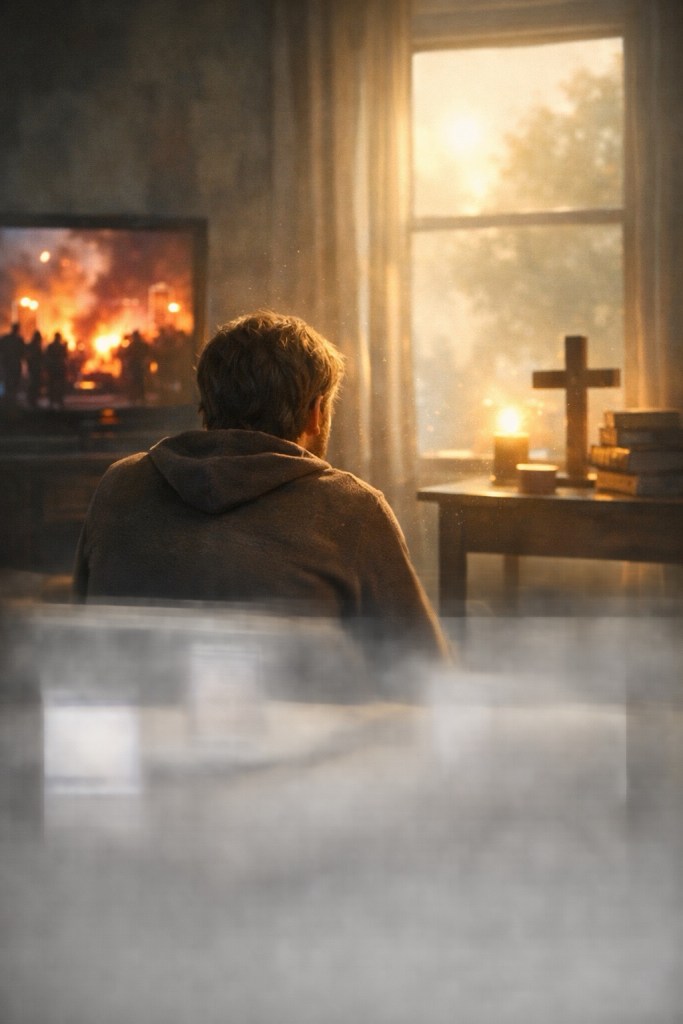
Most of us did not wake up planning to be angry.
We woke up to a screen.
Before coffee, before prayer, before hearing a real human voice, we were interrupted by an angry headline. Another video. Another fire. By noon we were already carrying a low grade tension, not quite rage, not quite despair, but something brittle. The kind of weariness that makes kindness feel optional and patience feel naive.
The problem is not that the world is suddenly chaotic. But that chaos has learned how to live in our pockets.
This is where the doctrine of divine blessedness sounds almost offensive. Blessed God? In this moment? With this much cruelty, unrest, and exhaustion? The phrase can feel detached, even irresponsible.
But Scripture does not use it to soften reality. It uses it to interrupt it. When Paul speaks of “the gospel of the glory of the blessed God” (1 Tim 1:11), he is not writing from comfort. He writes from a world thick with violence, imperial pressure, and social fracture. He names God as blessed not because history is calm, but because history is not ultimate.
That single claim quietly confronts the emotional unrest of the news cycle. It refuses to let outrage become the measure of faithfulness or despair become the mark of realism. It insists that beneath the noise of the moment there is a deeper reality. God’s own life is not unraveling. And because of that, neither must ours.
The News Cycle and the Formation of Fear
We tend to think of the news as information. In reality, it is formation. It trains our reflexes. It teaches us what to fear, how quickly to judge, and how little time to give one another. Even when reporting is responsible, the constant compression of tragedy into spectacle reshapes the soul.
Scripture is not surprised by this. The prophets assume that sustained attention to human volatility will distort vision. That is why Isaiah interrupts political terror with a strange recalibration. “All flesh is grass. The grass withers, the flower fades; but the word of our God will stand forever” (Isa 40:6–8). This is not denial. It is reordering. It reminds us that the instability of the moment is not the deepest truth about reality.
Divine blessedness reminds us that God is not one more anxious observer of events. God is not refreshing a feed, waiting to see how things turn out. God’s life is not reactive. It is complete. Makarios does not describe a mood. It names fullness.
A God who is blessed is not indifferent. A God who is blessed is free.
Why Panic Feels So Reasonable
Riots and unrest provoke a quiet but persistent question. Is this slipping beyond control? Is something essential breaking? Panic grows wherever we suspect that the good is fragile. That justice is too weak. That love is too thin. Divine blessedness answers this fear at the root. God is not merely sovereign. God is fulfilled. Paul calls him “the blessed and only Sovereign, the King of kings and Lord of lords” (1 Tim 6:15).
This matters more than we often realize. A God who needs history to go well in order to remain whole will always be anxious. A God who derives meaning from outcomes will always be threatened by failure. Scripture refuses this picture. Aquinas rightly argued that God is blessed not because he acquires some external good, but because he is his own goodness and life. God does not become fulfilled. He is fulfilled. That is not abstraction. It is the ground of divine patience. A God who is not scrambling can afford to be slow. A God who is not threatened can afford to be faithful.
Why Unkindness Is a Theological Crisis
One of the most painful features of the present moment is not only violence, but meanness. The habit of treating neighbors as symbols rather than persons is not just a social failure, it is a theological one. Unkindness assumes scarcity. It assumes that dignity must be defended aggressively. It assumes that if someone else gains, I lose. That logic does not belong to the life of the triune God.
The Father is not diminished by giving all that he is to the Son. The Son does not threaten the Father by receiving everything. The Spirit proceeds as gift without depletion. Divine blessedness names a life where giving does not end in loss. That is why Scripture so often links God’s blessedness with patience. “The Lord is merciful and gracious, slow to anger and abounding in steadfast love” (Ps 103:8). Slowness here is not weakness. It is the calm that comes from abundance.
When Christians excuse cruelty as necessary, what they are often confessing is fear. Fear that goodness will not hold. Divine blessedness exposes that fear without shaming it.
Blessedness and the Reality of Suffering
A concern usually rises at this point. If God is blessed, does that mean he is untouched by pain?
Scripture does not answer this in the abstract. It answers by pointing us to Christ. The Son does not reveal divine life by avoiding suffering. He reveals it by entering suffering without being conquered by it. Hebrews says that Jesus endured the cross, disregarding its shame (Heb 12:2). Disregarding does not mean ignoring. It means refusing to grant shame final authority.
Divine blessedness allows God to be fully present to grief without being destabilized by it. That is why biblical lament is honest and still hopeful. “Why, O Lord” is prayed to one whose life is already whole. Lament assumes blessedness, not its absence.
What This Means for Us Christians
Divine blessedness does not tell us to stop paying attention to the world. It tells us how to pay attention truthfully.
It frees us from the illusion that urgency equals faithfulness.
It makes room for courage that does not need to shout.
It exposes outrage as a poor substitute for hope.
It makes kindness possible when cruelty feels justified.
Most of all, it reminds us that history is not carried by our emotional intensity. It is carried by the perfect joyful constancy of God.
The news cycle will keep accelerating fear. Divine blessedness quietly resists that formation. It teaches the church to live from abundance rather than alarm, from participation rather than reaction.
In a culture addicted to immediacy, the blessed God is unhurried. And that unhurried fullness is not a retreat from the world. It is the only place from which the world can be loved without fear.
 Donnie's Dogmatics