Scripture reveals the Spirit as the fully divine giver of life who eternally proceeds from the Father and the Son and unites believers to Christ, bringing regeneration, sanctification, illumination, mission, and eschatological hope.
1. The Question Before Us
Christian theology eventually brings the reader to the living mystery of the Spirit. The Spirit is present everywhere in Scripture yet never seeks His own spotlight. The Father is revealed as source. The Son is revealed as mediator. The Spirit is revealed as the one who brings the presence and power of God into the lives of creatures. He is not an impersonal force. He is not the symbolic side of religion. He is not the mere breath of God. He is the living God who gives Himself to His people.
The early church struggled to find language adequate to the biblical witness. Monarchians denied His personhood because they could not see how another divine person could exist without dividing the divine unity. Pneumatomachians called Him a creature. Socinians reduced Him to a divine influence. Enlightenment thinkers made Him a religious metaphor. Berkhof surveys these trends and shows how consistently natural reason resists the biblical teaching that God Himself dwells in believers as their sanctifying Lord (L. Berkhof, Systematic Theology, 96 to 97).
The church’s teachers responded by returning to Scripture. Athanasius argued that the Spirit must be God because He imparts adoption. His reasoning depends on the biblical insight that one can receive only what the giver possesses. If the Spirit gives divine life, He must possess it (Athanasius, Letters to Serapion 1.24). Basil appealed to the fact that the Spirit receives equal glory and worship with Father and Son and therefore must share the same divine nature (Basil, On the Holy Spirit 16). Augustine saw the Spirit as the love of God poured into the hearts of believers by whom Christians cry Abba, Father (Rom 8:15), and he explained that this gift is personal rather than abstract or symbolic (De Trinitate XV.17). Calvin stood in the same lineage, insisting that the Spirit is the bond uniting believers to Christ so that the saving benefits of Christ’s work become theirs (Institutes 3.1.1).
This chapter follows that biblical path. Scripture delights to unveil the Spirit through the works He performs, and through that unveiling we see the glory of God’s triune life.
2. The Name and Biblical Pattern of the Spirit
The Old Testament uses the noun רוּחַ (ruach) nearly four hundred times. Its semantic range includes wind, breath, and spirit. In its basic sense ruach refers to something invisible yet powerful, something that moves with force and gives life. Wind moves through a field without being seen. Breath gives life to a creature. Ruach is used metaphorically for inner disposition, but the Old Testament consistently uses ruach of God’s active presence.
The Greek term πνεῦμα (pneuma) carries the same semantic field. Pneuma denotes breath and wind as well as the immaterial dimension of life. Because both Hebrew and Greek use the same term for wind, breath, and spirit, Scripture builds a theological pattern that links God’s creative breath with God’s personal action.
The Old Testament normally speaks of the Spirit of God or the Spirit of the Lord. Only Psalm 51:11 and Isaiah 63:10 to 11 use the explicit phrase “Holy Spirit.” Berkhof notes that the New Testament appropriates this phrase as the Spirit’s primary name because holiness is revealed in the Spirit’s indwelling and sanctifying presence (Berkhof, 95). The title “Holy Spirit” expresses His task to purify, consecrate, and renew.
The Greek expression τὸ πνεῦμα τὸ ἅγιον is deliberate. The article τὸ indicates specificity. The phrase does not mean a general sacred spirit but the Spirit who is holy in essence and who brings holiness to those in whom He dwells.
In the New Testament the Spirit receives this title repeatedly because the essence of the new covenant is the indwelling presence of God. The presence that once dwelled above the cherubim now dwells in the bodies of believers who become temples of the living God.
3. The Spirit in the Biblical Story
The Spirit is God who gives life and brings God to His people
The Spirit at Creation
Genesis 1:2 says, “The Spirit of God was hovering over the face of the waters.” The verb translated “hovering” is the Hebrew מְרַחֶפֶת (merachefet), a rare term used again in Deuteronomy 32:11 for an eagle hovering over its young. The image suggests intentional presence and protective care. Creation does not begin with impersonal energy. It begins with the personal movement of the Spirit who prepares the chaos for the ordering Word.
Psalm 33:6 deepens this revelation: “By the word of the Lord the heavens were made, and by the breath of his mouth all their host.” The parallel between דָּבָר (dabar, word) and רוּחַ (ruach, breath) shows complementary operations. The Word orders. The Spirit animates.
Job 33:4 personalizes this truth: “The Spirit of God has made me, and the breath of the Almighty gives me life.” The parallelism between πνεῦμα θεοῦ (pneuma theou) in the Septuagint and πνοή (pnoe, breath) highlights that the same Spirit who formed the cosmos forms the human person.
The Spirit Reveals God
Second Peter 1:21 states, “Men spoke from God as they were carried along by the Holy Spirit.” The Greek phrase is ὑπὸ πνεύματος ἁγίου φερόμενοι (hypo pneumatos hagiou pheromenoi). The participle φερόμενοι is used of ships moved by the wind. The Spirit directs revelation with personal agency.
First Corinthians 2:10 to 11 says, “The Spirit searches everything, even the depths of God.” The word ἐραυνᾷ (eraunai, searches) implies deliberate investigation. Paul uses the anthropology of human self knowledge to argue that the Spirit knows God as intimately as the human spirit knows the human person. “No one comprehends the thoughts of God except the Spirit of God.” This is a statement of deity.
The Spirit in the Gospel Story
Matthew 28:19 orders baptism into the single name of Father, Son, and Spirit. The singular ὄνομα (onoma) conveys unity of essence. The coordination of persons implies equality.
Acts 5:3 to 4 equates lying to the Spirit with lying to God. The narrative assumes the reader understands the theological implication.
Second Corinthians 3:17 declares, “The Lord is the Spirit.” Paul is not collapsing persons but asserting consubstantial glory. The Spirit exercises the liberating power of the Lord who revealed Himself to Moses.
4. The Personality of the Holy Spirit
Berkhof’s review of erroneous doctrines shows that denials of the Spirit’s personhood arise from philosophical assumptions rather than biblical exegesis (Berkhof, 96 to 97). Scripture’s claim is clear.
Personal Pronouns and Titles
In John 16:13 to 14 Jesus repeatedly uses ἐκεῖνος (ekeinos, he) for the Spirit. This is grammatically striking because πνεῦμα is neuter. The masculine pronoun signals personal identity. The title παράκλητος (parakletos) means advocate or counselor. It cannot refer to an impersonal force. First John 2:1 uses the same title of Christ.
Mind, Will, and Affection
The Spirit teaches (John 14:26). He bears witness (Rom 8:16). He intercedes (Rom 8:26). Paul uses the verb συναντιλαμβάνεται (synantilambanetai, He helps or takes hold with) to describe the Spirit’s intercessory aid. The Spirit distributes gifts “as He wills,” καθὼς βούλεται (kathos bouletai, 1 Cor 12:11). The verb βούλομαι means to will with deliberation. The Spirit grieves when His people sin (Isa 63:10; Eph 4:30).
Personal Actions
He searches, speaks, sends, warns, commands, and raises the dead (Acts 13:2; 20:28; Rom 8:11). These require personal agency.
Personal Relationships
He stands with Father and Son in Matthew 28:19. He stands with Christ in John 16:14. He stands with the apostles in Acts 15:28 where the phrase “it seemed good to the Holy Spirit and to us” treats Him as a participant in their decision.
5. The Trinity and the Spirit
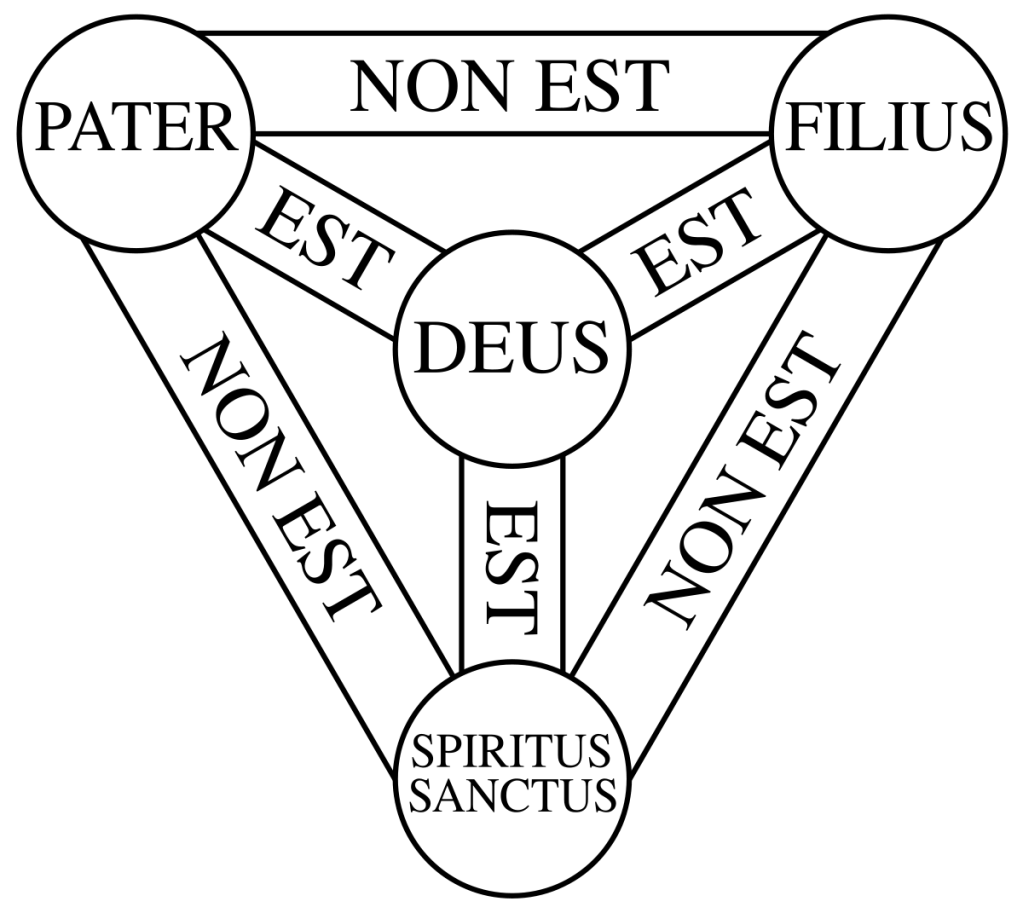
The Western church confessed the Filioque to express the biblical teaching that the Spirit proceeds from the Father and the Son. The Greek verb ἐκπορεύεται (ekporeuetai, proceeds) in John 15:26 refers to eternal origin. Jesus says the Spirit “proceeds from the Father.” Elsewhere Paul calls Him the Spirit of the Son (Gal 4:6) and the Spirit of Christ (Rom 8:9). The Spirit is sent by the Son (John 15:26). This pattern does not divide origins but reveals eternal communion and the unity of the divine life.
Berkhof defines spiration as the eternal act by which the Father and the Son communicate the one divine essence to the Spirit without division or change (Berkhof, 98). Generation belongs to the Father alone. Spiration belongs to Father and Son together. The Spirit possesses the full divine essence.
6. The Deity of the Spirit
Scripture establishes the Spirit’s deity through names, attributes, works, and worship.
Divine Names
Acts 5:3 to 4 calls Him God. Hebrews 3:7 to 9 equates His voice with the voice of God who spoke to Israel.
Divine Attributes
Psalm 139 shows His omnipresence. Isaiah 40:13 to 14 and 1 Corinthians 2:10 to 11 show His omniscience. Romans 15:19 displays His omnipotence. Hebrews 9:14 speaks of His eternal nature.
Divine Works
He creates (Gen 1:2). He regenerates (John 3:5). He sanctifies (2 Thess 2:13). He raises the dead (Rom 8:11).
Divine Worship
He stands in the baptismal command (Matt 28:19). Paul blesses the church with His communion (2 Cor 13:13).
7. The Spirit in the Divine Economy
Berkhof’s pattern summarizes Scripture. The Father plans. The Son accomplishes. The Spirit applies (Berkhof, 98 to 99).
In Creation
He forms the cosmos. He equips artisans and leaders (Ex 28:3; 35:35). He gives courage to Saul (1 Sam 11:6). He renews creation (Ps 104:30).
In Redemption
He prepares Christ’s humanity (Luke 1:35). He anoints Him (Luke 3:22). He empowers His ministry (Luke 4:18). He inspires Scripture (2 Pet 1:21). He births the church at Pentecost (Acts 2). He distributes gifts (1 Cor 12). He sanctifies (Gal 5). He leads believers into truth (John 16:13). He seals them unto the day of redemption (Eph 1:13 to 14).
Union with Christ
Romans 8:9 to 11 uses the phrase πνεῦμα Χριστοῦ (pneuma Christou, Spirit of Christ) to show that the one indwelling presence of God in the believer is the presence of the risen Christ through the Spirit.
The Spirit makes Christ present to His people and His people present to Christ.
8. Spiritual and Pastoral Use
The Spirit dwells in believers to assure them that God is near and that their adoption is real. The Spirit gives spiritual vitality, not as a reward but as a gift. The Spirit convicts without crushing. The Spirit sanctifies without shaming. The Spirit leads believers to confess Jesus as Lord. The Spirit pours love into the heart. The Spirit sustains hope when strength fails.
The Spirit does not make Christians impressive. The Spirit makes Christians alive.
 Donnie's Dogmatics